
Happy New Year!
From the President’s Desk
Welcome to 2026! While we replace our 2025 calendars to reflect the arrival of another year, we begin making plans for Chapters across Canada, gathering, following a brief break to spend the holidays with Family and Friends. Many Chapters have changed leadership, and we welcome those who recently stepped up, offering a diverse range of programming and ideas, and thank those who gave up time and commitment to make the Council the great organization it has become. One Chapter in Newfoundland even changed its moniker in honour of a long-time past leader.
Many of our curlers have been actively preparing for the Canadian Vision Impaired Curling Championships (CVICC), being held this year in Edmonton, Alberta during White Cane Week in February. We thank the many volunteers and organizers for their tireless work in continuing to make this a signature sporting event for CCB. (more information follows below).
While we prepare for White Cane Week, please remember that this is a valuable opportunity to highlight and display awareness and education to inform the public that vision loss can be preventable, but also that those who live the experience are very capable, despite their vision loss. The Council provides promotional materials to all Chapters participating in White Cane Week activity.
On behalf of the Board, Staff, and many donors and sponsors, we truly appreciate your ongoing support, as it continues to allow the Council the opportunity to expand its programming to meet the needs of its growing membership, and also supports our efforts to educate the public on avoidable blindness. In saying such, please ensure you get your eyes checked regularly.
Jim Tokos
National President
Member Spotlight
Seeing Differently: A Conversation with Shelley Ann Morris
This month we’re speaking with Shelley Ann Morris, a remarkable woman living with low vision. Shelley Ann’s experiences shed light on the wide range of vision loss—between total blindness and partial sight—and how that affects daily life, independence, and perception.
Welcome, Shelley Ann.
Thank you. I’m happy to be here.
Tell us a little about yourself. When did you first experience visual loss?
I was born with a condition called optic atrophy. It’s lifelong and stable—what I have now is what I’ll always have. I have no sight at all in my right eye, which is considered complete blindness. In my left eye, I have what’s known as tunnel vision, meaning I can only see through a small, restricted field. I’ve been assessed as having about ten degrees of usable vision.
That means I don’t see downward or to the sides—just a small section in the upper-right corner of my left eye. Even within that limited area, my vision isn’t sharp. I can’t recognize faces or easily read print. Interestingly, my vision improves somewhat at night, but bright daylight is very difficult for me. On sunny days, I see virtually nothing outdoors, even with very strong sunglasses. I use a white cane to navigate and rely on a range of adaptive technologies to make the most of the little vision I have.
Living Between Two Worlds of Sight
Many of the people we meet through the CCB, and the Get Together with Technology (GTT) program are totally blind. Total blindness is easier to understand—it simply means no sight at all. But Shelley Ann represents a large and often misunderstood group: those with some usable vision, but not enough to rely on in every situation.
What are some situations where your limited vision helps you—and others where you wish you had more?
One of my greatest advantages is being able to read conventional print. I can’t read small or low-contrast print, and I read more slowly, but I’m still able to do it. That’s a real gift because losing the ability to read print can be a huge barrier for many people.
My mother was wonderfully forward-thinking, and she taught me to touch type on an old manual typewriter when I was young. That skill has served me incredibly well.
As for challenges, they happen constant. Living with low vision means walking a fine line between blindness and sight, and people often make assumptions. If I’m using my white cane, some assume I read Braille exclusively or can’t get around on my own. If I’m not using it, they assume I can see everything. I can’t count the times when someone has said “over there” when I’ve asked for directions. Touch screens that time out quickly are particularly frustrating!
I’ve been asked on many occasions ‘why’ I don’t have a guide dog. This is a very personal decision, and for my purposes, a white cane works well for me.
Changes in familiar environments—like construction or rerouted entrances—can completely throw me off. And while most people are well-meaning, I’ve been grabbed and “helped” across streets many times without being asked first. It’s both awkward and unsafe.
Recognizing people visually can also be difficult. Since I can’t see faces clearly, I rely on voices and context. When someone greets me with “Hi, it’s me!”—I have to mentally sift through a catalogue of voices in my memory to figure out which “me” it is! This is not helpful at all.
“No Two People See Alike”
Would you say blindness exists on many levels?
Absolutely. We should never generalize or assume. Even among people with the same condition, experiences differ greatly. I don’t know what my low-vision friends can see, and they don’t know what I can see. The best approach is simple—ask before assuming.
Ask how someone prefers to receive information: large print, Braille, audio, and/or electronic formats. When offering assistance, ask how they’d like to be guided rather than grabbing an arm. A simple, “Would you like to take my elbow?” goes a long way.
Beyond Vision: Living Fully
What are some of your hobbies or interests that have nothing to do with blindness?
Most of my hobbies have nothing to do with vision loss! I love sports and fitness. I run with a sighted guide, cycle on a tandem bike, and attend spinning classes. I volunteer regularly, most recently at a folk music conference, helping check in volunteers and greeting attendees. Everyone there soon learned that I could not read their name tags and were only too happy to identify themselves by name.
I enjoy writing and belong to a book club where we listen to audiobooks instead of reading print. Blindness hasn’t limited what I enjoy, it’s just changed how I do things.
Climbing New Heights—Literally!
One of Shelley Ann’s most memorable achievements is her 21 climbs up the CN Tower in Toronto.
Tell us about that experience.
It started as a dare from my sister, who has full sight. She said, “I dare you to do the CN Tower climb.” I said, “Don’t dare me—I might do it!” And I did. The climb involves 1,776 steps, essentially the building’s fire escape.
It’s a fundraiser for various charities, but for me, it became a personal and family challenge. Once you know where the staircase is, you don’t need eyes to climb it, you need determination, some training, and the ability to climb stairs.
After 21 climbs, I’ve retired from that challenge, but the experience taught me that blindness affects only the eyes, not the spirit. A few of my friends who are blind or have low vision participate in running or walking clubs like Achilles Ottawa, where the social connection is just as important as the exercise.
Technology and Independence
Through the GTT program, Shelley Ann has discovered the power of technology. Her iPhone and iPad have become indispensable tools—she uses both VoiceOver and screen magnification depending on the situation.
One of the biggest breakthroughs for her has been apps that describe faces and scenes using artificial intelligence, bridging a lifelong gap.
She encourages anyone with sight loss—total or partial—to explore the technology and services available through organizations like the CCB, CELA (Centre for Equitable Library Access), and Para Transpo—Ottawa’s parallel transit system.
“You don’t have to be totally blind to qualify for support,” she says. “If it makes your life easier, use it!”
Final Thoughts:
Shelley Ann Morris reminds us that vision loss exists on a wide spectrum and that independence, confidence, and joy are not limited by what one can see. Her message is clear:
“Ask, don’t assume. Listen, don’t guess. And never let vision loss define what you can achieve.” Shelley Ann also stresses the importance of having peers in the blind/low vision community. “The community can be a real source of strength, providing both practical and emotional support.”
By the GTT Team, with the assistance of AI.
ANNOUNCEMENTS
In Memory- Honouring the Life and Legacy of Devon Wilkins:
The CCB family mourns the loss of a remarkable leader, advocate, and friend. Devon Wilkins, a long-time member and dedicated supporter of the CCB, passed away on November 4, 22025, leaving behind a legacy defined by service, creativity, and unwavering compassion.
Devon was truly a woman of many talents. She was an author, journalist, broadcaster, podcaster, poet, musician, and even an amateur radio operator. Her creative energy seemed endless, and she shared it generously with her community. Through her writing and storytelling, Devon gave voice to the experiences of people living with vision loss, always striving to educate, connect, and inspire.
Beyond her artistic pursuits, Devon was also a trained massage therapist and reflexologist, embodying her deep desire to help others. She lived her faith through action—offering comfort, encouragement, and practical support wherever she could.
Devon’s advocacy work was one of the greatest gifts she offered to the blindness community. Over the years, she served in leadership roles across several organizations, including the CCB, Guide Dog Users of Canada, March of Dimes Canada, and her local Lions Club. Her guidance was grounded in lived experience and a passionate belief in equality, independence, and dignity for all people with disabilities.
Those who knew her remember her as warm, determined, witty, and deeply caring. She faced challenges throughout her life, yet she met everyone with resilience and an unshakeable positive spirit. Devon had a gift for making others feel seen, supported, and valued. For many of us, she was not just a colleague—she was a friend, a mentor, and often a sister in spirit.
Her beloved circle of chosen family, her community in Peterborough, and her dear guide dog Jackson were central to her life. She spoke often about how blessed she felt to be surrounded by people she loved, and the feeling was mutual.
The CCB community extends its heartfelt condolences to Devon’s family, friends, and everyone whose life she touched.
Devon’s life reminds us that one person, with courage and conviction, can make a lasting difference. Her voice, her leadership, and her kindness will be deeply missed—but never forgotten.
Submitted by the CCB Peterborough Chapter
White Cane Week 2026:
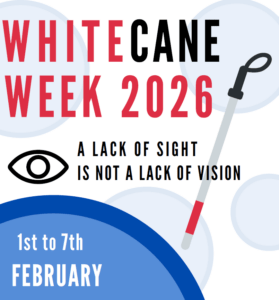
Get ready for a fun and exciting awareness week from February 1 to 7. This year’s events will include lots of local activities. Please visit the CCB website to keep yourself updated on the many exciting events that will be taking place this year across the country. And stay tuned for reports on events in upcoming newsletters!
Alberta Capital hosts 2026 Canadian Vision Impaired Curling Championship (CVICC):
In less than one month, the Vision Impaired curling elite from across Canada will assemble in Edmonton for the 2026 CVICC. This will mark the first time in the event’s rich history that it will be held west of Ontario.
Teams from New Brunswick, Nova Scotia, Ontario, Manitoba, Saskatchewan, Alberta and British Columbia will all compete in an attempt to dethrone last year’s champions from Prince George, BC, who will return and compete as Team Canada.
Our hosts for the event, The Edmonton Blind Curling Club, are looking forward to welcoming the curlers to their home club, The Granite Curling Club. The competition begins on February 2 with two draws a day on the first three days and 1 draw on Thursday to complete the round robin event. The championship culminates with five playoff draws on Friday, February 6th. Spectators are more than welcome!
Game results will be posted on the CCB National Social media offerings. The Gold medal game will be live-streamed; details to follow on our social media offerings. Scores will also be updated on the Curling.IO site in real time.
CCB National is proud of its rich history in supporting Vision Impaired curling. The CVICC has become the Council’s flagship event during its annual awareness campaign, White Cane Week.
World Braille Days (WBD) 2026:
Louis Braille famously said, “Braille is knowledge, and knowledge is power”. Each January 4, on his birthday, we celebrate the gift Louis Braille gave the world. The Alliance for Equality of Blind Canadians (AEBC), Alternate Education Resources Ontario (AERO), Braille Literacy Canada (BLC), the Canadian Council of the Blind (CCB), the Centre for Equitable Library Access (CELA), the CNIB Beyond Print, CNIB Foundation, the National Network for Equitable Library Service (NNELS), and the Provincial Resource Centre for the Visually Impaired (PRCVI) are pleased to collaborate on a celebration of World Braille Day for the month of January.
Braille Boost!
Do your fingers need a recharge after the holiday break? Check out Braille Boost – a series of fun braille games and activities to celebrate World Braille Day throughout January and beyond! These braille-related activities will include word puzzles and decoding tactile patterns. TSVIs and braille transcribers can download and emboss activities for big World Braille Month fun with their students. Materials for primary, intermediate/middle and secondary learners will be available in contracted and uncontracted UEB as well as French. Check the following site to register soon:
https://nnels.ca/world-braille-days-wbd-2026
Programming for Libraries
Celebrate World Braille Month this January with great programming ideas and resources available for free at AccessibleLibraries.ca. Find ideas to engage braille and non-braille readers of all ages in learning about Louis Braille and his amazing code that brought literacy to people with limited vision.
Webinar for Braille Readers
Braille Features on iOS and Android Mobile Devices
Software updates for Android and iOS devices have come a long way over the years, especially for braille readers. Whether you want to learn to type more quickly, or practice your braille writing skills, this workshop is for you! Our presenters will go in-depth into the braille features available on both iOS and Android mobile devices, including braille screen input.
Time: January 22, 2026, 1:00 PM (EST) 10:00 AM (PST)
Register: https://us02web.zoom.us/meeting/register/yhjcUhBYTRCT6OLkEhGzhg
Braille Calendars Shipping Now!
We are, at last, shipping our 2026 calendar bundles. This year’s desk calendar features twelve trees and their leaves. It is similar to the calendar we produced over ten years ago and remains one of our favourites. The little pocket calendar of course is meant to be portable, informative and entertaining.
You can find the 2026 calendar bundle on our site: https://tactilevisiongraphics.com/product/2026-calendar-bundle/
Tell Us About Your Experiences as a Parent with a Disability Using Federally Regulated Services in Canada!
Who are we looking for:
- Parents with a disability (physical, cognitive, visual, hearing) who have a minor child in their care
- Can express themselves in English or French or ASL or LSQ
What participation would look like:
- Participate in a pre-interview* about the project
- Use photos, memos, audio recordings to share your experiences of using federally regulated spaces (i.e. federal museums, banks, heritage buildings, national parks, federally regulated ferries etc.)
- Participate in a 60–90-minute interview*
- Participants will receive a gift card for their engagement
Who to contact if you want to participate: FamilyAccess@mun.ca
Thanks so much for your consideration!
*The pre-interview and interview will be audio/video recorded on MS Teams. In-person pre-interviews and interviews will also be audio/video recorded. Demographic
information will be requested at the end of the interview.
IN THE NEWS
Unlikely partnership forges potential Paralympic medal threats in alpine skier Eriksson, guide Smith:
Kimberley, B.C., native turned to competitive racing following visual impairment
Just five years ago, the idea of Kalle Eriksson competing for Canada at the Paralympics would have been unthinkable.
Now, he may just leave Milano Cortina as the country’s leading medal winner.
“I’m excited. I’m nervous. It’s really the only thing that’s in my thoughts right now,” Eriksson said. “So, it’s a big deal.”
Eriksson, a visually impaired Para alpine skier, will head to Italy for the Paralympics, which run March 6-15 with live coverage on CBC, with multiple podiums in his aim.
Yes, his is partially the story of someone undergoing a dramatic life change, gaining Paralympic eligibility and turning to sport as fuel.
But it is also the tale of a recreational skier learning to love competition through an unlikely partnership and family ties.
“I feel like this is a cheesy thing to say because a lot of people say it, but it’s true,” Eriksson prefaced of what a Paralympic medal might mean.
“A lot of blood and tears have gone into where we’re at today. And so, to see all that pay off in the long run, it’s kind of hard to look at it right now. But I know that if that moment does happen, it will really be an ‘OK, it was all worth it’ kind of feeling.”
In 2021, Eriksson was hanging out atop a ski hill with his father, Lasse Eriksson, who happens to be a longtime World Cup coach for Canada’s Para alpine team.
The younger Eriksson was just there to help at the training camp, aiding with administrative work like recording start times. He wasn’t wearing sunglasses or goggles.
About 24 hours later, he began noticing some vision loss. Then, it grew worse. Eriksson went to the hospital, where he was diagnosed with a welder’s flash — a cornea inflammation caused by overexposure to UV light. He was told it would be gone within a week or two.
Nothing changed. Eriksson followed up with a specialist.
“He pretty much told me that I was going to be legally blind for the rest of my life,” Eriksson said. “The sun reflecting onto the snow actually burned a hole right through my retina. Pretty much the same thing as if you were to look up at a solar eclipse.”
To that point, Eriksson had never particularly gravitated toward competitive skiing.
Instead, he preferred backroading it with buddies.
“Going out, hanging out, skiing, kind of doing whatever we felt like. Maybe go for a couple beers on the hill, whatever,” he said.
But one year after the incident, Eriksson received a call from a visually impaired ski team in Alberta, which asked if he’d be interested in joining.
“What the hell? Why not?” Eriksson responded. “I’ve been skiing my whole life. Might as well go out and try racing. [Then, I] kind of fell in love with it right away.”
Eriksson intended just to go for two weeks. After Day 3, however, he’d already found a groove, beating others who’d been at it much longer than he had.
International success came nearly immediately. During the 2024-25 World Cup season, Eriksson won 10 medals, including a pair of gold, one of which came at the Paralympic mountain in Cortina. He added two silver medals at the world championships in slalom and giant slalom.
The 21-year-old from Kimberley, B.C., returned to the slopes for this season in the fall but sustained a shoulder injury during a training camp in Chile, which forced him to miss the first World Cup of the season. He’s set to debut at the second World Cup in Santa Caterina, Italy.
Outside of his daily life — he began losing vision at the same time he was learning to drive and was forced to adjust to using public transportation with help from friends, for example — Eriksson’s biggest adjustment has come on the slopes.
The life of a competitive skier was somewhat foreign to him. Then, in Calgary, he found ex-Canadian national team skier Sierra Smith, who served as his guide.
It was a partnership that clicked immediately.
“Neither of us had any idea what we were doing. We were just like, ‘OK, well, I guess I ski in front of you now and you follow and we’ll see what happens,” Smith recalled. “And so, we did that and literally right after the first run, we’re like, ‘Holy cow, this is pretty cool.’”
Smith, the 25-year-old Ottawa native, has competed internationally since 2016, mostly at lower-level events.
She just happened to be assisting the Para team when Eriksson came to Calgary, and the pairing, she said, “just kind of fell into our laps.”
Now, Smith serves as Eriksson’s eyes during competition. They communicate through a headset, with Smith sending cues to Eriksson to help keep him on the course.
Communication is critical.
“No matter what sport you’re in, you have to have trust in your teammates. But in our sport, especially VI racing, she has to trust me to be safe behind her and I have to trust her to get me down the hill safely. And so, I think that just having good trust and a friendship in one another is a big part of it,” Eriksson said.
To that end, Eriksson and Smith spend plenty of time together away from the slopes to build their connection.
Activities include mountain biking, rock climbing and even line dancing — which was a weekly Thursday tradition in Calgary.
Smith has also helped nurture Eriksson’s competitive fire.
“From someone who didn’t grow up ski racing to where he is now … is really impressive,” she said.
Eriksson said racing is a “different mentality” than the casual skiing he used to do with his friends.
“To put ski boots on to go and compete was a weird feeling for me compared to putting ski boots on to go out and have a chill time, if you will,” he said.
Now, though, Eriksson and Smith’s desire to win burns bright. The Paralympics — and potentially multiple shots to step up onto the podium — beckon.
“It would be kind of an unreal feeling to me,” he said. “We’ve been moving pretty quick and I feel like that would be the cherry on top for Sierra and I.”
By Myles Dichter, CBC News
Canada Post Commits to Free Postage for People Who are Blind as Legislation Changes:
Canada Post is vowing to maintain free-postage service for people who are blind even as Ottawa’s budget bill looks to repeal those parts of the postal service’s legislation.
Bill C-15, the federal budget implementation act, contains a proposal to allow Canada Post to set its own postage rates. Right now, the Crown corporation has to seek Ottawa’s approval to change the price of a stamp.
But alongside those changes is the repeal of certain sections of the Canada Post Corporation Act. Specifically, the bill removes clauses that allow Canadians and organizations to send and receive — without paying any postage — books, letters and other materials used by people who are blind.
Laurie Davidson, executive director of the Centre for Equitable Library Access (CELA), said she was alarmed by the idea that those crucial parts of Canada Post’s legislation could be repealed.
CELA is a non-profit that provides accessible reading material, such as physical books in braille and audiobooks, to people who are blind, low-vision or have other disabilities that make reading difficult.
Davidson said adding postage to the thousands of shipments CELA sends out every year would be a “prohibitive” expense and would mean many Canadians who are blind or low vision would no longer receive materials from her organization and others like it.
The CNIB estimates 1.5 million people in Canada live with some form of vision loss.
Davidson said the free postage on accessible materials can be a lifeline for clients who live in remote areas and do not have ready access to a local library or digital alternatives.
“For all of these people, this would be a loss of format choice that would significantly impact their ability to equitably participate in Canadian society,” she said.
Providing free postage for people with impaired vision has been a part of the Canada Post Corporation Act since its inception in 1981, Davidson said, adding the practice may predate the legislation.
It’s also a tenet of the Universal Postal Convention, a United Nations-led pact that Canada has signed.
Officials from the office of Joël Lightbound, the federal minister responsible for Canada Post, said the government does not intend to walk away from its commitments under the postal convention.
They said the government has to repeal those parts of the legislation to give the postal service the power to change its own postage rates.
A Department of Public Services and Procurement Canada spokesman confirmed early in December the federal government will continue to compensate Canada Post for providing free postage to people who are blind.
“The transmission of materials for the blind will continue to be delivered free of postage and library materials will continue to be delivered at a reduced rate of postage,” the spokesperson said in a statement.
A spokeswoman for Canada Post initially said that the corporation was “aware of the proposed changes in Bill C-15” and would not comment further.
But after this story was initially published, the Crown corporation issued a follow up statement reconfirming its commitments under the Universal Postal Union, a specialized United Nations agency that governs the international convention.
“We are proud of our long-standing commitment to provide free postage for the blind and have no plans to change this service,” said spokeswoman Lisa Liu.
“As for Bill C-15, we’re not in a position to comment. We remain committed to our mandate of serving all Canadians, including those with disabilities.”
Davidson said she appreciates the postal service’s commitment, but the Crown corporation should have consulted members of the community in advance of any changes.
Even with the verbal commitment from Canada Post, Davidson said Canada could violate its responsibilities under the Universal Postal Convention by repealing relevant sections of the law.
She said she and other stakeholders will continue to push parliamentarians to amend Bill C-15 to protect clauses guaranteeing free postage on accessible materials.
By Craig Lord, The Canadian Press
CRTC Improves Accessibility of Programming for Canadians Who are Blind or Partially Sighted:
As part of its work to implement the modernized Broadcasting Act, the CRTC held a public consultation on how content could be more accessible on television and online for Canadians who are blind or partially sighted.
Based on the public record, the CRTC is introducing changes to better support Canadians who rely on described video and audio description. Canadians will be able to access new original scripted shows with described video, and news and information programs with audio description on television and online.
These changes will be phased in over the next two years, giving platforms time to adjust while helping ensure Canadians can access programming without barriers.
In the near future, the CRTC will publish a decision on closed captioning.
To find out more about the implementation of the modernized Broadcasting Act, check out the CRTC’s regulatory plan on their website here: https://crtc.gc.ca/eng/industr/modern/plan.htm
CNIB is Looking for Partners for the International Youth Internship Project (IYIP):
There is an exciting opportunity coming up with the CNIB International Youth Internship Project (IYIP). This initiative allows us to match talented youth interns with organizations outside of Canada for an enriching internship experience.
These internships are an excellent way for the interns to gain valuable experience while providing your organization with assistance on specific projects and tasks. There were a few questions regarding research on topics such as disaster preparedness or the Convention on the Rights of Persons with Disabilities (CRPD) in various countries. I’m pleased to inform you that our interns can indeed take on projects like these.
Our next cohort of interns will begin in early March, and we are currently seeking partners. If this opportunity interests you, please reach out to Michael Trolio at michael.trolio@cnib.ca.