
From the President’s Desk
Happy White Cane Week!
The Month of February is a significant time for CCB, as we celebrate White Cane Week (WCW) from February 1st through 7th. Organizationally this is an important time for our Chapters and Members to educate and demonstrate our abilities. This is done through displays across Canada where we promote such through public awareness and engaging with the many communities we represent. Furthermore, it’s an opportunity to promote the values and significance of the White Cane. Many of our Chapters have proclamations from local Government declaring the significance of WCW.
WCW begins Sunday afternoon where our British Columbia/Yukon Division kicks off the week with a two-part webinar, while simultaneously our curlers arrive in Edmonton to begin the Annual Canadian Vision Impaired Curling Championship (CVICC), our signature sports event. Be sure to tune in to the livestream of the CVICC on February 6th at 1:00 p.m. MST, featuring the Gold Medal game. We wish all participants good curling! (please see article below for more information).
The CCB will also be hosting a limited two-part webinar during WCW featuring two Canadian Paralympians with vision loss. Jason Dunkerley will present on February 2nd, followed by Priscilla Gagné on February 5th. These sessions promise to be inspiring and informative, and are not to be missed (please see article below for more information).
Please let us know what type of activities you participated in so we can share widely in upcoming editions of Visions. Our National Membership Committee members shared some outstanding ideas they were embarking upon for WCW, and it is important to share amongst all.
On behalf of the Board, staff, and many volunteers who support the cause, we wish everyone a very successful WCW. Whichever way you generate public awareness in regards to the significance of the white cane, our four-legged companions, our promotion of braille and tactile communication as well as assistive devices; it’s all important. Please don’t forget to get your eyes checked regularly!
Jim Tokos,
National President
Member Spotlight
We would like to introduce Karen Grewcutt from the CCB Calgary Chapter in Alberta.
My name is Karen GREWCUTT. I have been a member of the CCB Calgary Chapter for at least 10 years. I am a mom of one daughter and a grandma of one grandson. I enjoy doing activities with them and with CCB. I have been involved in Chapter activities such as swimming, curling, cribbage, aqua fit, and all the other fun activities we plan…like a summer picnic or the Christmas dinner!
I have been on the Calgary executive board as coordinator and pass coordinator. I have also been on the Alberta executive board as secretary and Southern Alberta sports coordinator.
Through the years, I’ve made many friends and had many good times and look forward to many more to come!
ANNOUNCEMENTS
White Cane Week 2026:
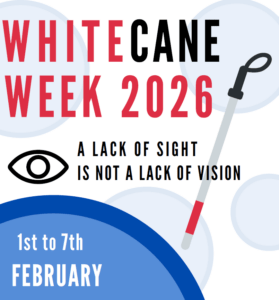
Get ready for a fun and exciting awareness week from February 1 to 7. This year’s events will include lots of local activities. Please visit the CCB website to keep yourself updated on the many exciting events that will be taking place this year across the country. And stay tuned for reports on events in upcoming newsletters!
CVICC is Now Underway!:
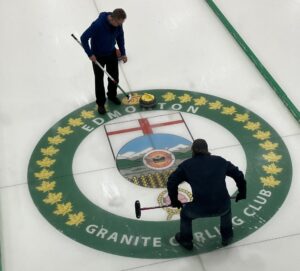
The 2026 Canadian Vision Impaired Curling Championship (CVICC) is taking place this week during White Cane Week.
The event is being held at the Granite Curling Club in Edmonton, Alberta. Our hosts, The Edmonton Blind Curling Club, under the leadership of Natalie Morin, have pulled out all the stops to make the event the most successful ever.
8 teams from across Canada are participating in the event. The team from Moncton NB, will be making their second appearance. We welcome back a team from Regina SK, after an extended absence, and 6 others teams will attempt to dethrone the current Champions from Prince George, BC.
This marks the first time ever that the event is being held west of Ontario, and we are sincerely enjoying the Alberta hospitality.
To keep up with the remaining action, you can follow the scores and standings by visiting the following website:
https://sydney.curling.io/en/events/26985-canadian-vision-impaired-curling-championship
The CCB Social media platforms will also feature a recap of the remaining goings on this week.
The Gold medal game (the championship) will also be live-streamed on the CCB YouTube channel. Here is the link:
https://www.youtube.com/live/RiEkMwRo710
A special thanks goes out to the local organizers in Edmonton and the many volunteers who are playing a key role in the success of CVICC 2026. Thank you also goes out to the athletes; you folks are the stars of the event.
If you reside in an area where there is a vision-impaired curling group and would like to become involved, please contact us, and we’ll put you in touch with the local coordinator. Likewise, if you live in an area where there is no Vision Impaired curling, but you would like to explore the possibility of starting up a group, let us know, and we can lend some support.
The CCB is very proud of its rich history and involvement with the Vision Impaired curlers across Canada. It is another clear example focusing on the abilities, rather than disability, of persons living with vision loss.
White Cane Week Webinar: A Limited Two-Part Series:

Hear from leaders who push boundaries and redefine what is possible.
Join us online for two live presentations and Q&A sessions featuring Canadian Paralympians who are blind/have low vision.
Jason Dunkerley, Paralympian – Middle-distance runner
Monday, February 2, 6:00–7:00 PM EST
Zoom Registration at the following link: https://us06web.zoom.us/webinar/register/WN_4a3bmE0PTlW0e1OECeKQuw
Hear from Jason Dunkerley, a five-time Paralympic middle-distance runner and medalist who has represented Canada for over 25 years. After immigrating to Canada from Northern Ireland, Jason discovered his passion for running and went on to build an elite athletic career while navigating blindness. Beyond sport, he is an author, musician, and federal sport policy professional who continues to champion inclusive physical activity and equitable access to sport for people of all abilities.
Priscilla Gagné, Paralympian – Para Judo
Thursday, February 5, 7:00–8:00 PM EST
Zoom Registration at the following link: https://us06web.zoom.us/webinar/register/WN_5AiFzw3ESO6rN782qkgRSg
Hear from Priscilla Gagné, the first Canadian woman to win a medal in Para judo at the World Championships, earning bronze. She went on to win gold at the Pan American Para judo Championships in both 2018 and 2020, followed by a silver medal at the Tokyo 2020 Paralympic Games. At Tokyo, she also had the honour of serving as Team Canada’s flag bearer during the Opening Ceremony.
CCB BC-Yukon Division WCW 2026 Virtual Events Information:
Please Join us!
Once again, the CCB BC-Yukon Division is planning virtually a WCW event via a Zoom Webinar:
Webinar – Thursday February 5th at 10:00am pacific time
Hosted by Iris Thompson and Bob Gallaugher
“Author, Global Advocate, Educator & Volunteer”
Featuring Charles Mossop
How to Connect with Us
Please click this link to join us:
https://us02web.zoom.us/j/83770875695?pwd=RbUwmgEbPiX5c30uy6lJpJKmUwms26.1
(you will be asked to enter your email and name; and once connected, you will be automatically muted during the presentation)
Or join by using one tap mobile:
+17789072071,,83770875695#,,,,984590# Canada +16475580588,,83770875695#,,,,984590# Canada
Or dial in: (when phoning you will need to punch in the webinar ID and password)
Webinar ID: 837 7087 5695
Passcode: 984590
Find your local number: https://us02web.zoom.us/u/kb7jzp2iPo
Contact us before the webinar and we can call you to connect you. For more information email info@ccbbcyukon.com or ann4council@telus.net or call 604-795-3885 or 1-800-874-4666.
It’s Back… and Better Than Ever! Join us for the next Coast-to-Coast-to-Coast Bistro Night!:
Saturday, February 28th, 2026
7:30pm–9:30pm Atlantic
6:30pm–8:30pm Ontario
(Adjust for your time zone)
The Zoom room opens 15 minutes early, so pop in, get settled, and get ready for an evening full of connection and great vibes.
Just like before, we’ll kick things off with a warm meet-and-greet, then it’s all music, music, music!
Enjoy singing, piano, guitar, and a wonderful mix of English and French tunes, shared by talented performers from across the country.
Performers: Spots fill up quickly, so be sure to register early to secure your moment to shine!
Come join us to relax, listen, laugh, tap your feet, and enjoy the magic — all while sipping your favourite drink from the comfort of home.
To register or for more information:
Email Louise at lburley@ccbnational.net
Don’t miss it — an evening of music, connection, and coast-to-coast community awaits!
For All Lovers of Birds!:
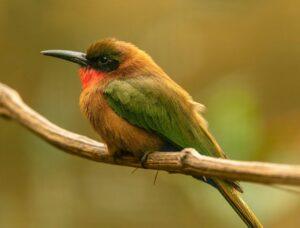
Did you know that there are many opportunities for birding by ear for people who are blind or have low vision?
If you are not already enjoying birding by ear, we would like to encourage you to begin. It’s a great way to connect to the natural world.
Here are some ideas on how you can begin or improve your birding by ear skills.
1. Check out the Birdability website, which has a lot of great resources.
- If your local blind and low-vision community already has access to birding-by-ear events, that’s fantastic! We’d love to hear about it; please let us know at steve@torontobirding.ca
- Otherwise, depending on the size of your community, there may be one or more birding groups that organize outings for birders in general, and they might be able to help you find good birding locations that meet your transportation and accessibility needs. They might even have some birders who could join you and help you identify birds by ear, if you’re new to this. We would encourage you to reach out to local birders and let them know that you are interested in learning to bird by ear.
- Google is probably your best bet for finding birding groups or individuals that organize walks in your community.
2. On May 3 and 4, 2026, you can participate in the Blind Birder Birdathon.
- The idea is to get out and find as many birds by ear as you can. Details of the event including a registration link can be found at the Birdability site. Click here: https://www.birdability.org/blind-birdathon
- The Toronto Ornithological Club (TOC) will be involved in this event in Toronto, and we are also undertaking to promote it nationally across Canada.
- We encourage you to organize a group of blind and low vision birders, or you can participate in the Birdathon on your own – just register on the Birdability site.
- And we will be advertising this event to birding groups across Canada so you may find a local birding group that is organizing something for this event.
If you have any questions or anything you’d like to share, please contact us at:
steve@torontobirding.ca
Participants Needed for a Master’s Student Research Project on How AI Influences Independence for individuals who are blind or have low vision:
How does AI support your sense of independence? We are looking for individuals who are blind or have low vision between the ages of 20 to 65 who either use artificial intelligence with visual assistive technologies or would like to use AI-enabled assistive devices to navigate their daily spaces.
Your participation will involve:
- Participating in an interview lasting 90 to 120 minutes
- A remote or in-person co-design activity based at OCAD University
- Conversations will feature questions about how you navigate environments using AI visual assistive technologies and thinking about what it means to be independent.
Why participate?
- Have your anonymized stories included in a report that will be used to develop inclusive, human-centred technologies.
- Receive either a $25 Amazon or Canadian Tire gift card for your time, the choice is yours.
Eligibility:
- Must have access to downtown Toronto and/or access to online meeting platforms.
- Aged 20 to 65
- Individuals are required to be blind or have low vision
To participate or learn more, contact:
Michael Pivar: Master’s in Design, Inclusive Design Candidate
OCAD University
pivarm@ocadu.ca
IN THE NEWS
Paralympic Skier Danelle Umstead Is Blind and Has MS. She’s Won 3 Olympic Medals — ‘I Know What I’m Capable Of’:
It was late October in 2010 when blind Paralympic skier Danelle Umstead first noticed something was wrong. She’d just finished an intense day of training and skiing, but her right foot was tingling, and she was having trouble taking off her ski boot.
“I thought I’d gotten a little frostbite,” she says. “But I was crying because it really hurt.” Her husband and ski guide, Rob Umstead, chalked it up to fatigue. But the tingling sensation persisted — and the next day, when she woke up, her right side was completely paralyzed. “From my rib cage all the way down to my toes on my right side — I couldn’t move,” recalls Umstead. “I couldn’t walk. I couldn’t sit up. I screamed to Rob, and he picked me up and took me to the emergency room. I thought I’d had a stroke.”
Over the next few months doctors searched for answers, at first telling Umstead she had transverse myelitis, a rare neurological condition in which the spine is inflamed. They prescribed steroids and physical therapy, but after several more episodes of numbness, Umstead was diagnosed with multiple sclerosis. “It was a very hard journey,” recalls the now 54-year-old. “I had to learn how to walk again, how to run again — and I had to learn to ski again. And that’s when it really sunk in how MS had control over my body.”
Umstead is one of an estimated 1 million Americans suffering from multiple sclerosis, a chronic autoimmune disease that attacks the central nervous system, causing lesions on the brain and spinal cord — and leading to a wide range of symptoms, including dizziness, tingling, numbness, vision problems and fatigue, among others.
While there’s no cure for MS, there are currently more than 20 treatments available to help patients live longer, fuller lives.
“I’ve been practicing for over 25 years,” says Dr. Tanuja Chitnis, a neurologist at Mass General Brigham in Boston, “and in the early days, we had one or two treatments with efficacy rates in the 30 percent range. Now we can get up to 70% efficacy. Thankfully, it’s a very different state for patients. Doctors are getting better at using the high-efficacy treatments early on, and this is very important.”
For Umstead, life with MS has had its challenges, but she’s learned to adapt to her limitations and make the most of her opportunities. She and Rob went on to compete in three more Paralympics, capturing a career total of three bronze medals in the downhill and super combined.
“He’s my best friend,” says Umstead from the Park City, Utah, home she shares with Rob and their 18-year-old son Brocton, a high school senior. “Rob sometimes believes in me more than I believe in myself,” adds the Texas native, who competed on Dancing With the Stars in 2018 and later founded a nonprofit called Sisters in Sports Foundation for disabled female athletes.
“MS has taught me to redefine my strength,” says Umstead, who’s also built a thriving career as a motivational speaker. “I’ve learned to listen to my body, slow down, adjust and not fight.”
The youngest of three daughters to Connie, a telemarketer, and Peter D’Aquanni, 80, president of an airline food distributor, Umstead grew up in Plano, Texas. When she was 5, her parents divorced, and she and her sisters lived with their mother.
“I learned at a very young age that I was going to go blind,” she says. “From the age of 2, I had these very thick Coke bottle glasses. I was running into things, falling off curbs, running into parked cars. I grew up feeling ashamed of my disease.”
At age 13, she was diagnosed with retinitis pigmentosa (RP) — a rare genetic condition that often starts in childhood, causing gradual deterioration of the retina and progressive vision loss. “I remember being in the doctor’s office and hearing this disease is incurable,” she says. “The only thing in my mind was, ‘You’re going to go blind.’ I felt like I was drowning.”
Umstead’s shame and grief over her disability haunted her for more than a decade. “It sealed the deal that I would never fit in,” she says. With no central vision in her right eye and correctable vision in her left eye, she struggled at school. “It was awful,” she says. She graduated in 1990 and found a job as a professional debt collector, eventually working her way up to manager. “They valued me as an employee, even as my eyes were deteriorating,” she says. “I thought life was handing me something wonderful for the first time.”
Sadly, that all came to a sudden halt in 1996, when her mother was diagnosed with stage 4 colon cancer. “I would drive her to her chemo appointments,” recalls Umstead, “which I shouldn’t have been doing — and she would put a towel over her head and say, ‘Let me know when we get there.’ We lived in laughter and love and comedy. She was amazing.”
Connie died in 1999, and within a year, at age 28, Umstead had lost all of her vision. “I felt like losing my mom caused the deterioration of my vision at a rapid pace,” she says. “I was unable to drive. I lost my license; I lost my job — and my will to live. It all came crashing down.”
Hope — and the chance for a new life chapter — came a year later, in a way that she never could have imagined. Her father, whom she wasn’t especially close with (“He definitely isn’t warm and fuzzy”), invited her to go skiing with him in Taos, N.Mex.
“I was terrified,” says Umstead, recalling how her father skied down in front of her, shouting commands to “turn right!” or “turn left!” and to “get up! get up!” every time she fell. “It was the first time since I’d lost my mom and my vision that I felt pure joy,” she says. “I truly believe my father gave me life twice. That man led me to my husband, he led me to the Paralympics — and led me to who and where I am today.”
Less than a year later Umstead left the flats of Plano for the mountains of Taos, where, in February 2005, she met Rob, a former college ski racer and ski coach from Massachusetts, at a local bar after a day on the slopes.
They were wed three years later, on April 18, 2008, “at the top of the mountain in Snowbird, Utah,” says Umstead. “And literally from that day forward, he’s guided me in life and on the slopes. We started a career together from the day we married. We’ve learned so much about each other through our sport; I couldn’t imagine my life without him.”
Two years later, they competed as a couple in the 2010 Paralympic Games in Vancouver — with Rob skiing ahead, calling out commands to Umstead through headsets in their helmets. “Everyone told me it was impossible,” she says. “I had just learned how to ski and race as an adult, and I was at the age where elite athletes retire.”
Incredibly they won two bronze medals in the downhill and super combined — and set their sights on gold in Sochi in 2014. Six months later, while they were training in Copper Mountain, Colo., Umstead experienced the tingling and paralysis on her right side that would lead to her MS diagnosis. “I was very, very scared of what was happening to me,” she recalls. “My body was something I’d always had control of.”
Following her diagnosis, she began taking medication — and in the years after that, she did her best to manage her symptoms and keep her athletic career on track. During the offseason away from the slopes, she would walk and run and work out in the gym regularly.
But when it came to the start of the ski season, “I had to relearn the skiing on my right side all over again because I wasn’t doing it every day, like walking and running,” says Umstead, who competed in three more Paralympic Games before retiring in 2024. “People didn’t see that part, what it took for me to get into that starting gate after MS. Each and every time.”
Over the past 10 years, she’s been on three different medications — until she stopped altogether during COVID because the treatments suppressed her immune system. She admits she’s “at a horrible crossroads” now because her insurance has changed, and her doctor isn’t on the new policy.
She’s had three significant flare-ups in the past five years (all treated with steroids) and says, “I’m just fatigued a lot more often than I have been in a long time. And my speech is starting to slow down a little bit.” But none of that has kept her from living the life she loves: maintaining her daily workouts — including stretching, walking and weight training — skiing with son Brocton, who’s headed for college in the fall, and traveling regularly for her motivational speaking engagements.
“Sometimes resilience means resting. Sometimes it means asking for help,” she says. “I’ve learned a lot from my MS — to step back and give myself time and permission to adapt.”
By Joanne Fowler
Have your say: Help shape our draft standard on Wayfinding and Signage:
Accessibility Standards Canada is launching the public review of its draft standard on Wayfinding and Signage. The standard aims to make navigation in buildings and public spaces easier, safer, and more accessible. We need your feedback.
Read the draft standard:
Share your comments before March 30, 2026, at 11:59 p.m. (Pacific Standard Time).
About the standard:
The CAN-ASC-2.4 – Wayfinding and Signage draft standard sets out best practices to help people navigate indoor and outdoor spaces safely and independently. The standard supports environments where everyone can understand where they are, where they need to go, and how to get there. It includes requirements for:
- lighting and contrast,
- interior and exterior wayfinding (including Tactile Walking Surface Indicators),
- signage design and installation,
- tactile and braille elements,
- pictograms and graphical symbols,
- audible and electronic signage,
- maps.
We developed the standard with people with disabilities and other industry experts. It promotes multiple ways of accessing information: visual, tactile, auditory, and digital. This ensures people can find and understand information in the way that works best for them.
A new way to participate:
To participate in the public review, use our new online portal and public review form. If you already have an account, sign in to participate. If not, create your account today.
By creating a user account, you can:
- save your progress and return anytime,
- reuse your information for future public reviews,
- view your past submissions in one place.
We’ve designed these new tools to make your experience simpler and more accessible. If you need support, email us at asc.standards-normes.asc@asc-nac.gc.ca
Help us spread the word:
Please share this opportunity within your networks and encourage others to take part. Your input helps us build a safer, barrier-free Canada for everyone!
Accessible Canada Roadmap Released:
Employment and Social Development Canada (ESDC) released the Accessible Canada Roadmap: Towards a barrier-free Canada by 2040. The Roadmap is a national framework that supports and anchors the efforts of Canadians working to create a barrier-free Canada by 2040.
Automatic Tax Filing:
Starting in the 2026 tax year, pre-filled tax returns will be available on the Canada Revenue Agency’s (CRA’s) My Account online filing system and automatically filed for about one million lower-income individuals with simple tax situations. This offering will be scaled up to about 5.5 million individuals for the 2028 tax year.
Budget 2025 Items Update:
The federal government tabled Budget 2025 in November, in which they committed to:
- Not treating the Canada Disability benefit as income under the Income Tax Act, protecting recipients from clawbacks in other federal income-tested programs such as the Canada Child Benefit.
- Introducing a new one-time $150 supplemental payment to help offset the cost of applying for or renewing the Disability Tax Credit.