
From the President’s Desk
While periodically we feel spring is in the air, winter continues to remind us of its existence across Canada. While we reflect on February, I wish to thank all involved in White Cane Week which transpired from coast to coast throughout February. I’d like to congratulate all of the participants of the Canadian Vision Impaired Curling Championship (CVICC), as participation in this event makes everyone winners!
We also thank all of Our Chapters across Canada who took the time to reflect on education and awareness, the key to White Cane Week. Additionally, we are indebted to the International Olympic Committee who kindly considered our White Cane Week prior to the start of the Olympic Games in Milano-Cortina, as they awaited our WCW events to conclude!
Members of CCB have also been involved in issues concerning safe and accessible transit, and we continue our work in wayfinding and signage. Our ongoing work with Canada Transport Agency (CTA), who handles transport under Federal jurisdiction such as air, rail, ferry and bus. Many of our Chapters are involved with Provincial and local transit to ensure accessibility and removal of barriers is front and center.
The Council also continues to advocate for free postage for the blind, which is so important to us who send and receive reading materials albeit large print, braille, and recorded materials from library services across Canada, and if you read on, you’ll find an important announcement on this issue. It is imperative to note that our CCB advocacy committee continues its work on the above items as they evolve, supporting our membership and partners.
Realizing we are all looking forward to Spring and Summer events, we thank everyone for their ongoing planning and work towards ensuring the success of our spring and summer activities benefit our valued members.
On behalf of the Board, staff, partners, and many volunteers, we thank everyone for their commitment to White Cane Week, and the great platform it provides the Council to educate the meaning of the white cane and demonstrates our abilities as persons living with vision loss. To note that an integral part of the public education is to remind everyone to ensure they get their eyes checked regularly.
Jim Tokos
National President
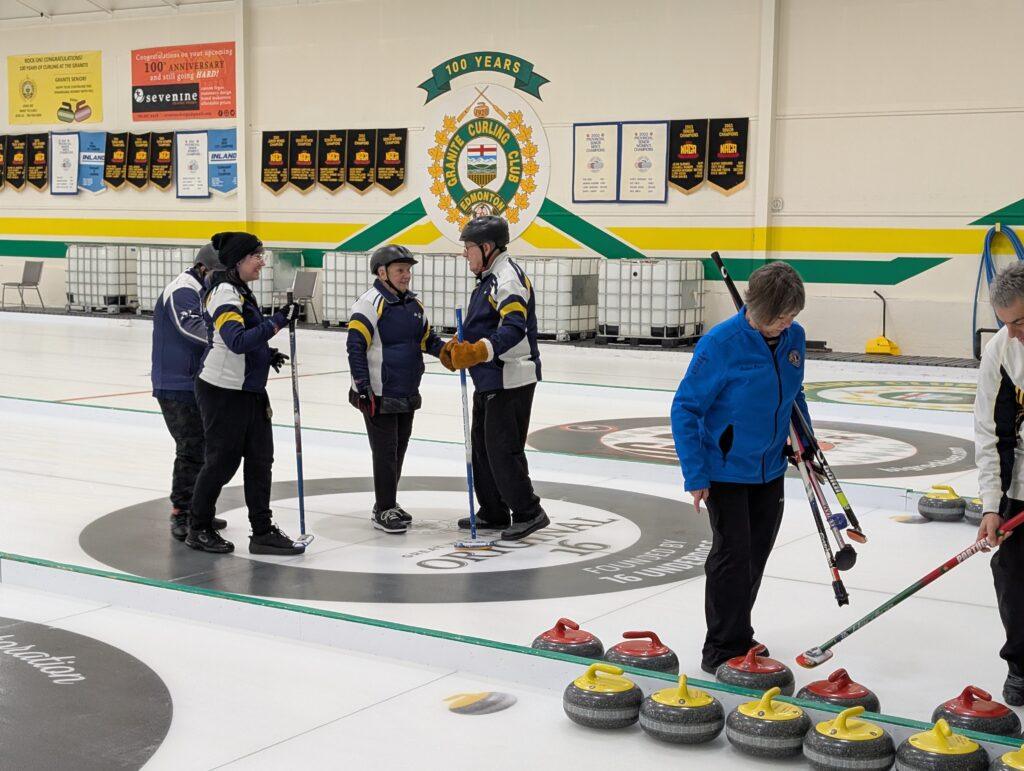
(The picture above shows players from Team Nova Scotia and Team Canada on the ice at the Granite Curling Club rink in Edmonton, Alberta, most holding curling brooms. Red and yellow curling stones are lined up in the bottom right of the image.)
Member Spotlight
Elmer Thiesen: A Life Shaped by Determination, Not Vision Loss:
Elmer Thiesen’s journey with vision loss began early. By the age of four, he had lost his night vision. During the day, he functioned reasonably well—or so he thought. As the years passed, he slowly became aware that he was missing details others seemed to notice with ease. Reading print was possible but difficult, and throughout his school years he sat at the front of the classroom, still struggling to see the board.
Growing up on a farm, Elmer learned to drive tractors and vehicles in open fields. Later, he obtained a driver’s license after disclosing that he could not see at night. Although he was allowed to drive for about a year, he now looks back and admits that he probably should never have been on the road. Giving up driving was painful—something that took months, not days, to accept.
Today, Elmer has no functional vision, with only a pinpoint of light perception in his right eye. Yet his work life tells a powerful story of perseverance. As a teenager and young adult, he worked multiple jobs, all requiring bright lighting due to his lack of night vision. After marrying his wife, Sherry, the couple moved to Vancouver to pursue a government-supported training program. When that experience proved frustrating—especially due to a lack of accessible materials—they returned to Abbotsford.
Elmer then spent nearly 20 years working in tire stores, doing everything from sales to physical labour. That chapter ended abruptly when he was terminated by phone between Christmas and New Year’s—a difficult blow for a family with four children. The growing use of computers in the workplace, without adequate accessibility, played a significant role in that decision.
What followed, however, became one of Elmer and Sherry’s greatest successes.
Through a small opportunity to clean a medical clinic, the couple discovered a new path. Encouraged to take over a contract, they applied—and were accepted. Over time, they built a cleaning business that grew to as many as 13 contracts, most of them medical facilities. The business remained a family operation, eventually including their son. Rather than expand further and hire staff, they chose to keep quality and control at the heart of their work.
Technology later became one of Elmer’s most powerful tools. Although he never learned Braille, two years of high-school typing proved invaluable. He adopted the iPhone with the release of the iPhone 4S, after discovering VoiceOver. Initially convinced he would never download apps; Elmer now uses well over a hundred. Through patience, trial and error, and determination, technology has become essential to his independence.
“I wouldn’t want to be without it now,” Elmer says. “I wouldn’t be able to read, or function as well as I do.”
When asked what he would say to someone newly facing vision loss—perhaps reading Visions in a doctor’s office—Elmer’s response is practical and hopeful. He encourages people to explore accessible technology, connect with organizations such as CCB, CNIB, and others, and most importantly, reach out.
“There are people who want to help,” he says. “And if I can help in any way, I’d be glad to.”
Elmer Thiesen’s story reminds us that while vision loss changes how we live, it does not define what we are capable of becoming.
By [the GTT Team], with the assistance of AI.
ANNOUNCEMENTS
Western Hospitality and GREAT curling were both evident in abundance at the Canadian Vision Impaired Curling Championship (CVICC) held recently during White Cane Week in Edmonton:
2026 was the first time that the championship was held west of Ontario, and the Edmonton Blind Curling Club (EBCC), our hosts, did an outstanding job in making the event one of the most successful to date.
The curling took place at the home rink of the EBCC, the Granite Curling Club. The management, staff and volunteers at the club did an amazing job in welcoming and hosting the curlers, and the ice was first-rate!
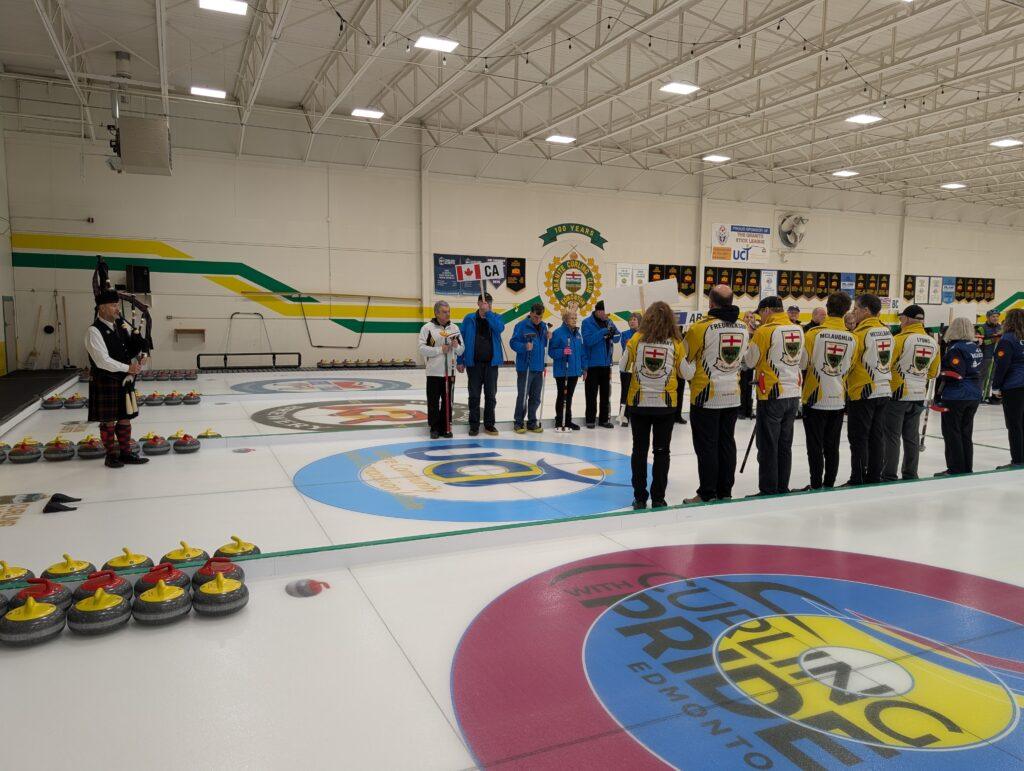
(The picture above shows several curlers from different teams lined up in two rows facing each other inside a curling rink. To their left, a person is playing the bagpipes. Several yellow and red curling stones are visible on the ice.)
Curlers from 7 provinces participated in the event to see who could dethrone last year’s champions from Prince George, BC.
After a slight delay caused by a few airline issues, the event began with opening ceremonies where the curlers were piped in and welcomed to the event. The first ceremonial rock was delivered by Roger Morin, who was honoured at the event. Roger has been instrumental in the development of Blind curling in Western Canada and was in attendance at the first Blind Curling event hosted by the Lions Club of Calmar Alberts some 52 years ago.
Round robin action began on Monday afternoon and when the dust had settled at the end of the day on Thursday, these were the final standings.
Alberta, 7 – 0
Team Canada, 6 – 1
British Columbia, 4 – 3
Nova Scotia, 4 – 3
Ontario, 3 – 4
New Brunswick, 2 – 5
Manitoba, 2 –5
Saskatchewan, 0 – 7
Friday saw some exciting playoff action, and in the final two games, Alberta defeated British Columbia 8 to 4 to win the gold medal and is now the new Team Canada. BC will take the silver, and Nova Scotia, which defeated the outgoing Team Canada 7 to 2 in the other playoff game, will take home the bronze.
Team Alberta members (the new Team Canada):
Skip, Natalie Morin
Third, Roger Morin
Second, Steve Vandereems
Lead, Lori Hysert
Sweeper, Carrie Anton
Coach/Guide, Mandy Collins
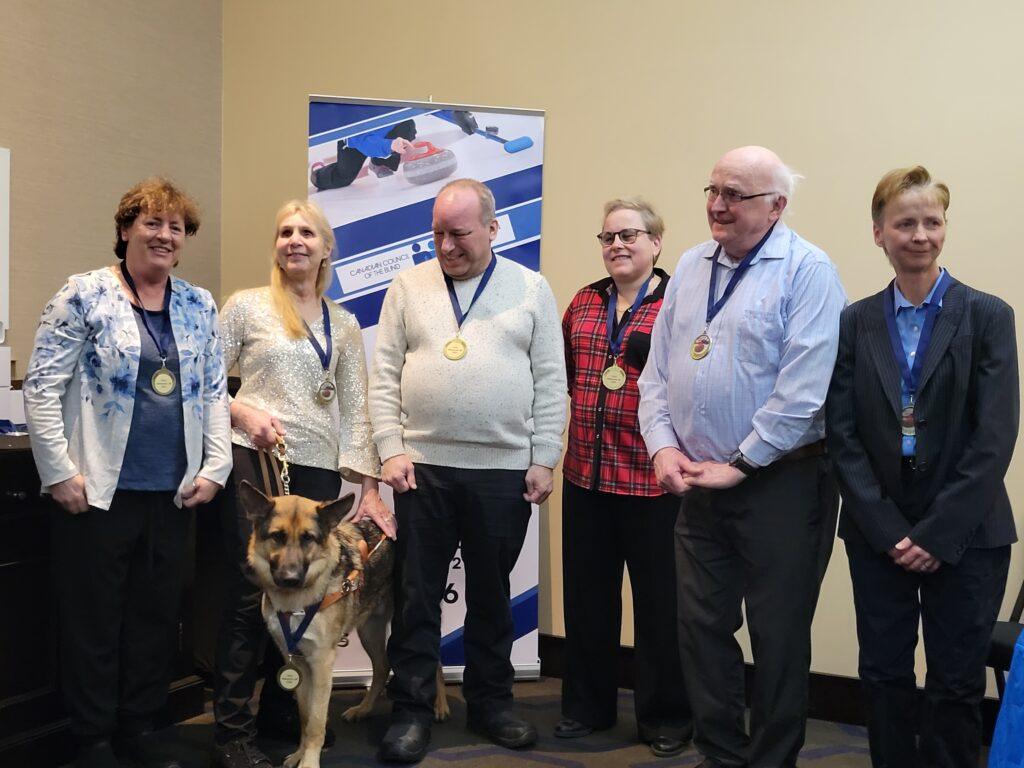
(The picture above shows all six Team Alberta players standing lined up next to each other and posing for the camera. In front of Lori Hysert is her guide dog. The CCB poster is behind them.)
Along with the curling, participants enjoyed a “meet and Greet” evening where pizza was served, and friendships were rekindled or born. A fun-filled Trivia night with a great dinner (thanks to our supporters). A trip to West Edmonton Mall and a fantastic wind-up banquet held at our host hotel, The Sandman South Edmonton.
Speaking of supporters, we would like to give special thanks to both the Beverly Optimist Club in Edmonton and the Alberta Sports and Recreation Association (ASRAB) for their generous financial support of the event.
There are so many people to thank for making the event the success that it was.
Thank you, Yvon Lefort, our event umpire who joined us from Sydney NS, as a volunteer to officiate the entire week.
Thank you, Natalie Morin (President of the Edmonton Blind Curling Club), Lori Hysert and Carrie Anton, all part of the local organizing committee. You did amazing work!
Thank you, Rob Creswick, who did the majority of the driving during the week, including airport pickups, hotel to rink transportation, and various other trips.
Thank you to all the other volunteers and supporters of the event. We could not have done it without you; you folks made it happen!
A special thanks goes out to team Ontario and team New Brunswick for their patience. They both faced lengthy delays during their travel, especially NB coming home. We are sorry that happened to you!
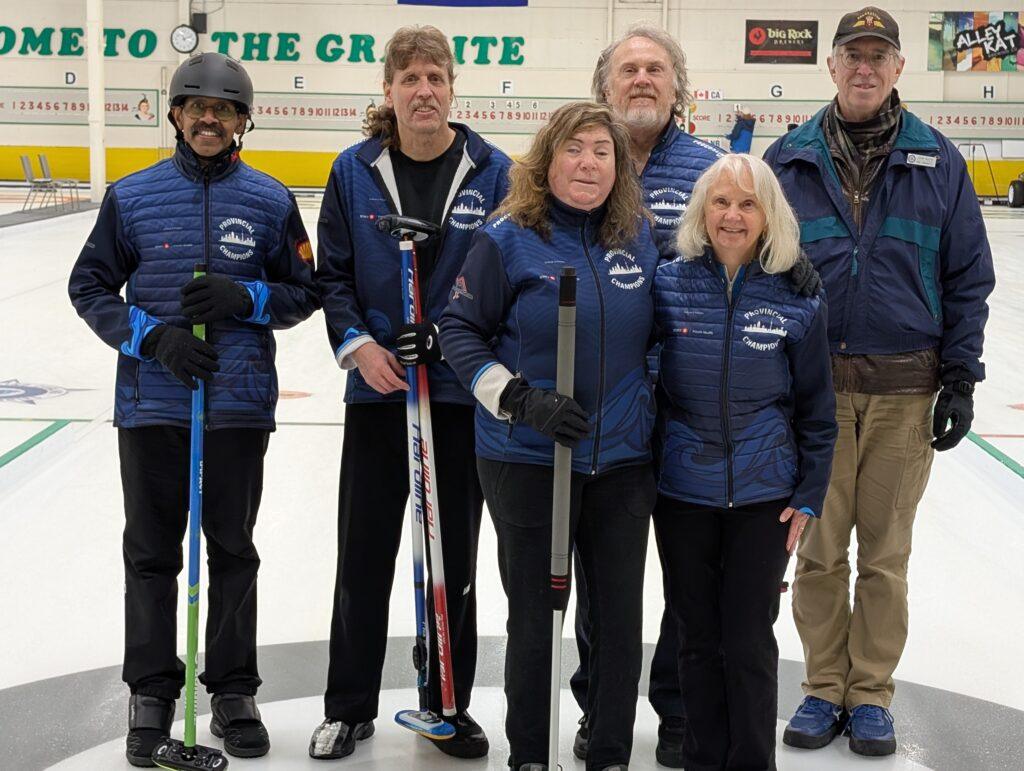
(The picture above shows players from Team Ontario standing side by side on the ice in a curling rink, posing for the camera. They are wearing their navy blue team jackets and holding curling brooms.)
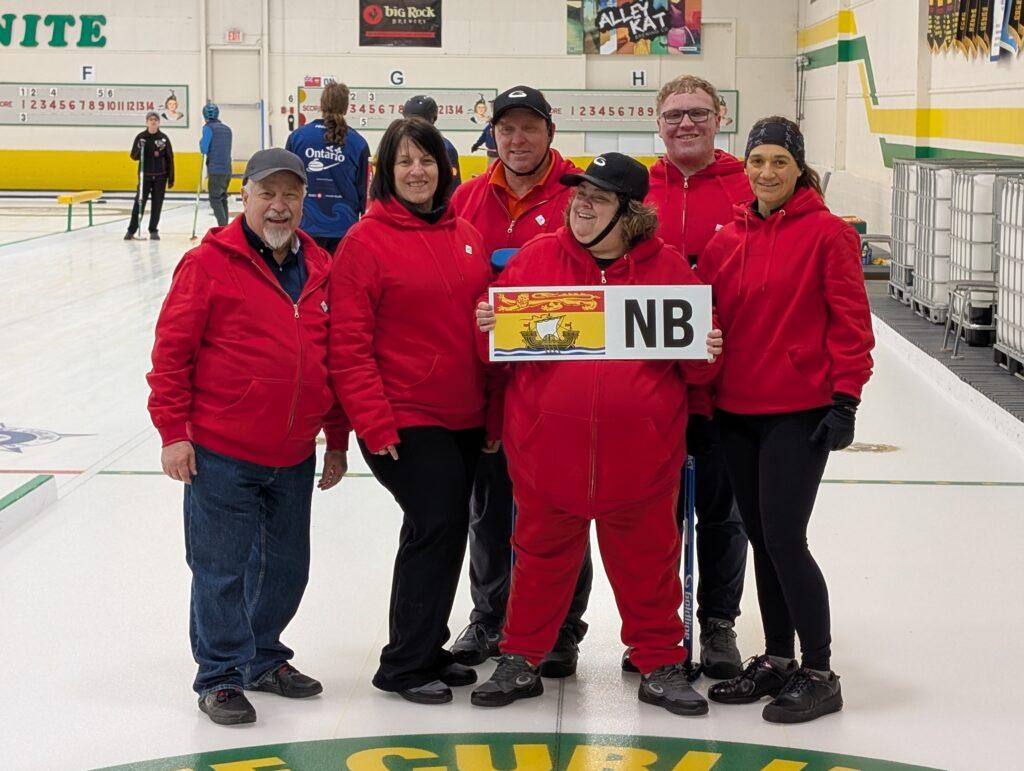
(The picture above shows players from Team New Brunswick standing side by side on the ice in a curling rink, posing for the camera. They are wearing their red team jackets. One player, Natalie Fougère, is holding a sign that shows the New Brunswick flag on the left and “NB” on the right.)
And last but not least, the Curlers and Guests who travelled far to be a part of the event. You are all champions. You all are “rock stars”. Thanks for participating!
The CCB is extremely proud of its rich history and involvement in the sport of Vision Impaired Curling. We look forward to continuing our support of the curlers and look forward to hosting the event again in 2028, as the event now shifts to a once-every-two-year format.
Find Your Strength & Balance – Accessible Virtual Yoga:
Join Yvonne every Saturday at 10:00 AM EST on Zoom for a welcoming virtual yoga class that is blind-friendly and accessible through descriptive cueing.
Yvonne, a visually impaired member of the CCB, focuses on gentle strengthening and stretching exercises to improve balance, increase flexibility, and help prevent falls. You’ll build stability, body awareness, and confidence in a supportive environment, all from the comfort of your own home.
Classes are $10 drop-in, your first class is free, and no commitment is required. One-on-one sessions are also available.
Whether you are new to yoga or have prior experience, this class offers practical tools to help you move with greater ease and independence in everyday life.
For more information or to register, please email Yvonne at yvonne@ymgcommunications.com.
Women of CCB Monthly Gatherings:
Join us for our Women of CCB monthly gatherings, held on Zoom every second Tuesday of the month at 7:00 PM Eastern (8:00 PM Atlantic). These welcoming and supportive sessions feature engaging guest speakers, meaningful themed discussions, and plenty of time for casual, lighthearted conversation with other women living with sight loss.
Whether you’re looking to learn something new, share your experiences, or simply connect with others, there is always a place for you here.
If you are not familiar with Zoom, we are happy to call you directly by phone so you can participate with ease. Heidi and Leslie warmly welcome you and look forward to having you join us.
If you are interested in participating, please email Heidi at hwhite@ccbnational.net.
Art You’re Allowed to Touch: Lynda Todd Brings a Barrier-Free Exhibit to ECCO Gallery, Lakefield, Ontario:
ECCO Gallery is proud to present an exhibition by multi-award-winning mixed media artist Lynda Todd, running March 4 through April 5, 2026.
Touch is encouraged.
This captivating show continues Todd’s powerful Migration Series, featuring richly textured portrayals of polar bears, penguins, and whales, created using mixed media techniques. Each piece captures the movement, resilience, and beauty of migratory wildlife across land, air and sea.
Todd’s work has gained major recognition. Her piece Salmon, Salmon, Salmon has been selected for display in the Ontario Parliament (Toronto, 2026) through the Art a la Carte collection. She is also the recipient of the Outstanding Emerging Artist Award from the Electric City Culture Council and has exhibited internationally, including in Korea and Japan.
Unlike a traditional art exhibit, this is a hands-on sensory experience where visitors are encouraged to engage through touch, creating a deeper connection to the artwork and the natural world it represents.
Todd explains, “Most galleries teach people not to touch. I’m doing the opposite. This exhibit is built so everyone can experience art fully, not just look at it.”
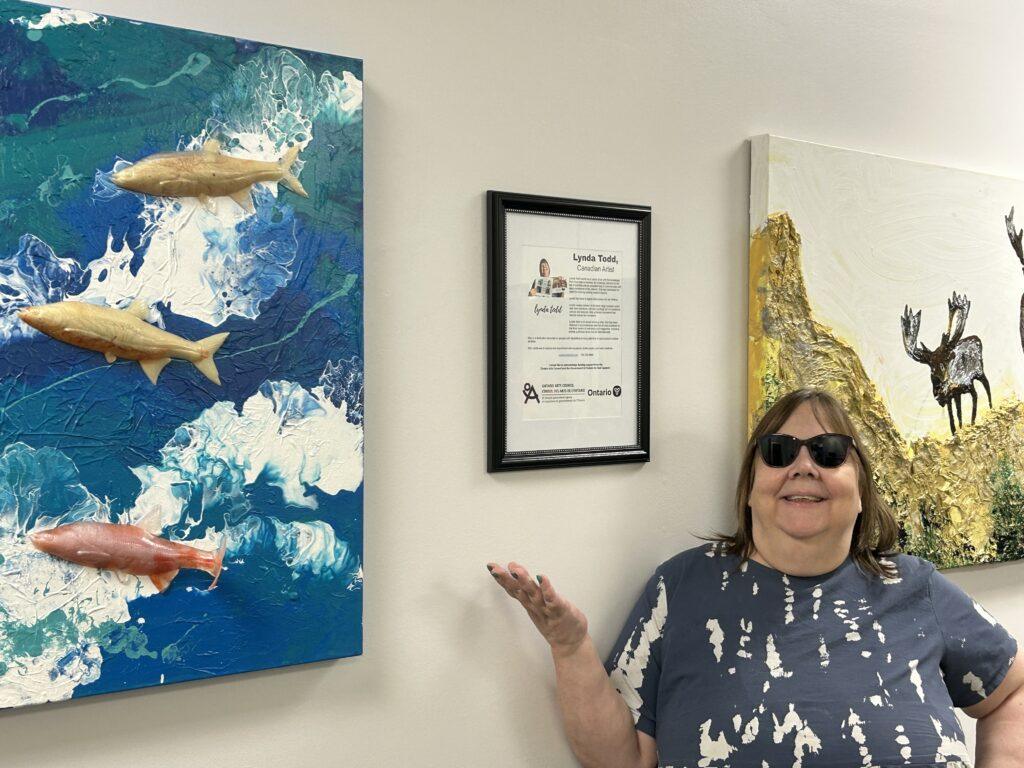
(The picture above shows Lynda Todd, wearing black sunglasses and a navy and white shirt, standing beside her artwork on a wall and gesturing toward it. The canvas on the left depicts three fish swimming in ocean water, and the canvas on the right shows a moose above a white background with golden scenery below.)
Accessibility is a cornerstone of this exhibition. Visitors can scan QR codes beside each piece to hear audio descriptions, and large-print and Braille identification cards will be available to support a more inclusive gallery experience.
“Art is something you feel. This exhibit invites everyone into the experience, through touch, texture, and connection.”
– Lynda Todd
Todd is visually impaired and colour blind but has found her niche through bold colours and strong textures. She is passionate about proving that accessible exhibits can be created, and hopes galleries everywhere begin making inclusion the standard.
“This exhibition changes how people experience art. Lynda’s work is bold, textured, and filled with movement, but what makes it truly special is that everyone is welcome to engage with it through touch. It is art without barriers.”
– Jody Ridpath, Curator, ECCO Gallery
Artist Reception
Saturday, March 7, 2026
1:00 p.m. – 4:00 p.m.
Meet Lynda Todd and experience the exhibition firsthand.
More info: www.lyndatodd.com
Artist Talk at Community Care Lakefield
You’re Invited!
A Creative Afternoon with Artist Lynda Todd
Community Care Lakefield is pleased to invite you to a relaxed and inspiring afternoon featuring multi-award-winning artist Lynda Todd.
After the talk, guests are invited to attend a private tour of Lynda’s exhibit at ECCO Gallery.
Monday, March 16, 2026
2:00 p.m. – 3:00 p.m.
The Common Room
40 Rabbit Street, Lakefield, ON
Community Care Office: 705-652-8655
Free to attend.
Exhibit: Echoes of the Senses by Lynda Todd
Dates: March 4 – April 5, 2026
Location: ECCO Gallery, 46 Queen St., Lakefield, ON
Reception: Saturday, March 7, 1–4 p.m.
Admission: Free
www.lyndatodd.com
Accessible Features: Touch encouraged, QR audio, large print, Braille labels, Art hung lower, sighted Guide Available
“This isn’t a special exhibit for accessibility. This is what the standard should look like.”
Update: Coast-to-Coast-to-Coast Bistro Night, Originally Scheduled for Saturday, February 28, 2026, has Been Postponed; New Date TBD:
The Coast-to-Coast-to-Coast Bistro Night that was originally scheduled for Saturday, February 28th, 2026, was postponed due to unforeseen circumstances.
We sincerely apologize for any inconvenience this may have caused and appreciate your understanding.
A new date has not yet been confirmed, but we will share the updated details with you as soon as it is.
We look forward to gathering together soon for an evening of music, connection, and coast-to-coast community!
Thank you for your continued support, and stay tuned for updates.
Bill C-15 (2025 Budget Implementation Act) Update:
In February, the House of Commons Finance Committee approved amendments to Bill C-15 (2025 Budget Implementation Act) that reinstate protections for free literature for people who are blind and reduce postage rates for library materials under the Canada Post Corporation Act.
The new wording reads:
Exceptions — rates
(3.1) The Corporation must provide for
- a) the transmission by post, free of postage, of letters, books, tapes, records and other similar material for the use of the blind; and
- b) a reduced rate of postage for library materials lent by a library to a borrower, including by means of an interlibrary loan.
Bill C-15 will now return to the House of Commons for Report Stage and 3rd Reading. Once it passed, it will move on to the Senate. We do not anticipate any major changes to this section, and there should be no further impact on Canada Post rates for library materials or materials for the use of people who are blind.
We thank everyone who supported this important advocacy effort, including the National Network for Equitable Library Service (NNELS) and the Centre for Equitable Library Access (CELA), who collaborated with the Canadian Urban Libraries Council (CULC), the Canadian Association of Research Libraries (CARL), and Public Library InterLINK on this issue. They also worked alongside the CNIB, CCB, Braille Literacy Canada (BLC), and other disability partners.
Together, all of our voices have made a meaningful difference.
For more updates, please visit:
CELA: https://celalibrary.ca/blog/federal-budget-calls-elimination-free-literature-blind
NNELS: https://nnels.ca/news/bill-c-15
Traveling with Sight Loss Just Got Easier:
Best Kept Secrets for Travelers With Sight Loss is the first book aimed at giving travelers who are blind or have low vision the tools to make travel safe and fun. It provides reliable advice on topics including planning and packing for a trip, traveling domestically or internationally by plane, train, and ship, navigating in unfamiliar places, traveling alone or with a companion, traveling with a guide dog, finding your way around your hotel and organizing your room, dining in restaurants, using apps and other technology to make travel easier, and much more.

(The picture above shows the cover of Lynn Jensen’s book. The title reads “Best Kept Secrets for Travelers with Sight Loss” in capital blue letters. On the left is a drawing of the Eiffel Tower with trees and dark silhouettes of three people walking. On the right is a black sketch of a woman walking with a white cane with a red stripe. Below, the author’s name reads “Lynn Jensen BSN RN CVRT” in blue font.)
Author Lynn Jensen lost her sight shortly after getting her nursing degree, but she hasn’t let it keep her at home. She has traveled the world with family, friends, and on her own with her trusted guide dog. As a certified vision rehabilitation therapist, Lynn has provided plenty of advice for her clients about traveling with sight loss, and now she has put all that advice into her debut book.
The book is available in paperback (regular and large print), e-book, and audiobook (MP3 and DAISY) formats.
You can get a copy through the main online retailers or the official website, www.BlindTravelTips.com
“Balance” with Douglas Panton: Part 2 — A two-part series on balance, movement, and confidence for those with vision loss:
You are warmly invited to join the second session of our two-part Balance series, presented by Douglas Panton and open to all CCB members.
Due to the strong interest and high attendance at our first presentation, this session will be hosted as a webinar to allow more participants to join and will conclude with a live Q&A session.
Balance can be a concern for many people living with vision loss and understanding how to support it becomes increasingly important over time. This series is designed to be inclusive, practical, and meaningful for anyone who wants to move through daily life with greater confidence and stability.
Presenter – Douglas Panton
Douglas Panton is an Anatomy and Physiology Professor from Victoria, BC. In the first presentation, Doug spoke about balance, why it can change over time, and how vision loss can influence it. Participants shared their questions and experiences during the session.
The second presentation will focus on practical ways to improve balance and reduce the risk of falls, using gentle, accessible “basic stances” drawn from martial arts. These techniques are not about self-defense or strenuous activity, but about learning stable positions that can help support safer, more confident movement in everyday life.
Webinar Details :
Webinar Link: https://us06web.zoom.us/j/87819129798
Date: Thursday, March 5, 2026
Time: 7:30 PM NLST; 6:00 PM EST; 3:00 PM PST
If you were unable to attend the first presentation and would like access to the recording, or if you would like additional information, please contact us at ccb@ccbnational.net or Jim Hamilton at: jim.hamilton@rogers.com.
We hope you’ll join us for this important and informative presentation!
For All Lovers of Birds!:
Did you know that there are many opportunities for birding by ear for people who are blind or have low vision?
If you are not already enjoying birding by ear, we would like to encourage you to begin. It’s a great way to connect to the natural world.

(The picture above shows two small, colourful birds with patches of green, blue, yellow, turquoise, red, and black, standing on a thick branch during the day.)
Here are some ideas on how you can begin or improve your birding by ear skills.
1. Check out the Birdability website, which has a lot of great resources.
If your local blind and low-vision community already has access to birding-by-ear events, that’s fantastic! We’d love to hear about it; please let us know at steve@torontobirding.ca
Otherwise, depending on the size of your community, there may be one or more birding groups that organize outings for birders in general, and they might be able to help you find good birding locations that meet your transportation and accessibility needs. They might even have some birders who could join you and help you identify birds by ear, if you’re new to this. We would encourage you to reach out to local birders and let them know that you are interested in learning to bird by ear.
Google is probably your best bet for finding birding groups or individuals that organize walks in your community.
2. On May 3 and 4, 2026, you can participate in the Blind Birder Birdathon.
The idea is to get out and find as many birds by ear as you can. Details of the event including a registration link can be found at the Birdability site. Click here.
https://www.birdability.org/blind-birdathon
The Toronto Ornithological Club (TOC) will be involved in this event in Toronto, and we are also undertaking to promote it nationally across Canada.
We encourage you to organize a group of blind and low vision birders, or you can participate in the Birdathon on your own – just register on the Birdability site.
And we will be advertising this event to birding groups across Canada so you may find a local birding group that is organizing something for this event.
If you have any questions or anything you’d like to share, please contact us at:
steve@torontobirding.ca
Everyday Self Advocacy-Small Steps, Big Impact:
Self advocacy is one of the most powerful tools we have as people living with vision loss. It isn’t about being loud, demanding, or confrontational. At its heart, self advocacy is simply about communicating what you need so you can participate fully, safely, and confidently in your community. And the truth is: if we don’t tell someone that something isn’t working for us, nothing changes.
Below are some practical, real life tips to help make self advocacy feel easier, more comfortable, and more sustainable.
1. Speak Up: Because Silence Changes Nothing
People can’t fix what they don’t know about. Whether it’s a poorly placed sign, a hallway light that’s burned out, or a website that isn’t accessible, others often assume everything is fine unless they hear otherwise. Your voice is the spark that starts improvement.
Advocacy doesn’t have to be a speech or a formal complaint. Sometimes it’s as simple as saying, “This doesn’t work for me, could we try something different?”
2. Firm, Not Forceful: The Power of a Polite Ask
There’s an old saying: you catch more flies with honey than vinegar. It’s true. You can advocate firmly and clearly without raising your voice or sounding demanding.
A respectful tone helps people stay open, curious, and willing to help. It also reflects well on our whole community. Many people have never met someone who is blind or partially sighted before, and your interaction may shape how they treat the next person who comes along. Even on the days when you’re tired, frustrated, or dealing with someone who doesn’t “get it,” choosing patience and kindness can open doors.
3. Choose Your Battles: Small Advocacy Matters Too
Advocacy doesn’t always have to be about big systemic change like accessible transit or audible pedestrian signals. Small, personal changes are just as important:
- Asking for a tactile marker on your mailbox
- Requesting better lighting in a hallway
- Asking you’re building to mark indoor steps
- Requesting a menu in an accessible format
These small wins improve your daily life and they add up. Trying to advocate for everything, for everyone, all the time leads to burnout. Focus on what matters most to you and give yourself permission to take things one step at a time.
4. Think of Advocacy as Asking for Help: Not a Battle
Advocacy becomes much less intimidating when you break it down into simple questions:
- What exactly is the problem?
- What would help?
- Who is the right person to ask?
- How should I contact them, email, phone, in person, or a message?
- What will I say?
- How can I be clear, concise, and polite?
And remember gratitude goes a long way. Even if someone can’t help, thanking them for their time keeps the door open. If they can help, acknowledge it. If they help only a little, thank them anyway. If they suggest someone else, thank them for that too. Politeness is not weakness—it’s strategy.
5. You Represent All of Us
Whether we like it or not, many people will meet only one blind or partially sighted person in their entire life. That means their interaction with you becomes their mental “template” for our whole community.
That’s a lot of pressure, especially on a long day when you’re exhausted or dealing with someone who is uninformed. But it’s also an opportunity. By being patient, polite, and educational even when it’s hard you help build a more inclusive world for everyone who comes after you.
6. Celebrate Your Wins: They Matter
Every time you advocate for yourself, you’re strengthening your confidence and helping others understand accessibility a little better. Small victories deserve recognition. They remind you that your voice matters and that change is possible.
Final Thought
Self advocacy isn’t about being perfect. It’s about being honest about what you need, communicating it clearly, and treating others with respect along the way. When we advocate for ourselves, we’re also advocating for our community. And when we do it with kindness and clarity, we make the world a little easier for the next person.
Article written by the CCB Advocacy Committee.
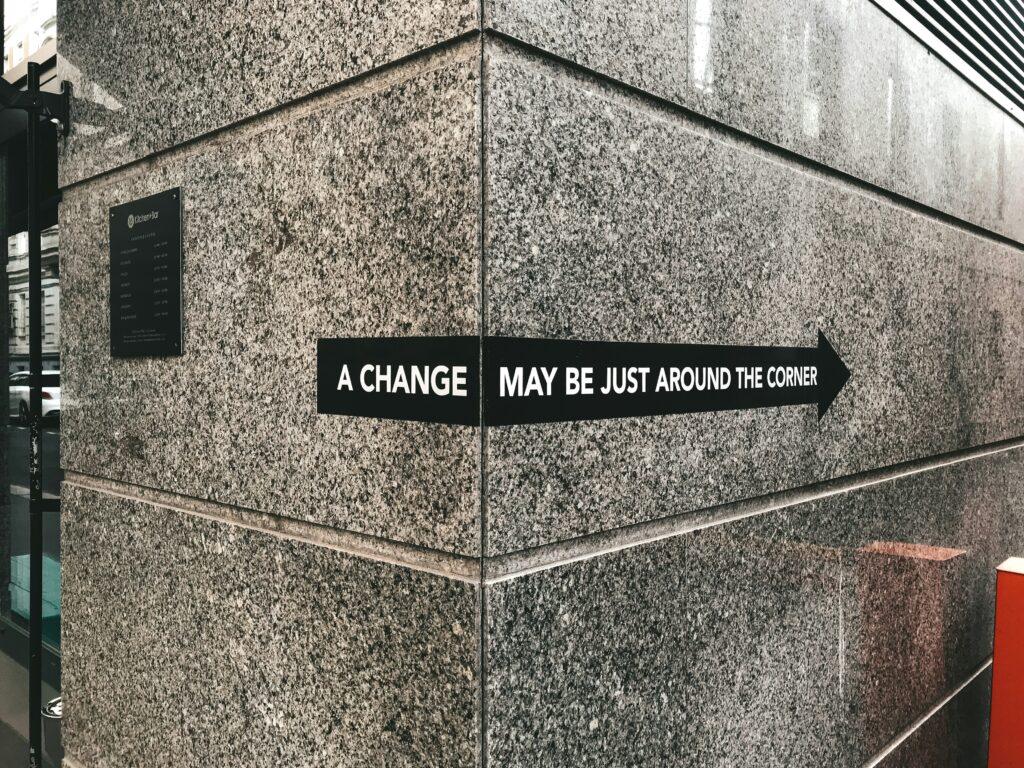
(The picture above shows the corner of a grey wall in a building with a black strip running across the center. The strip reads “A change may be just around the corner” in capital white letters.)