
Happy Thanksgiving and Halloween!
From the President’s Desk
While we quickly transform from Summer to Fall, it is a busy time for the Council across Canada. Chapters will be collecting membership dues as well as planning activities for the 2026-2027 season.
October welcomes World Sight Day, on the 8th, observed annually on the second Thursday of the month. This is a Global event intended to draw attention to blindness and visual impairment. Thanksgiving Day is on Sunday, the 11th, in Canada. And we can’t forget October 31st, which is Halloween, a time for children and those still young at heart to dress up as their cherished character, while carving up their pumpkins.
October certainly is a month of opportunity to reflect and educate our lived experiences as blind and partially sighted persons, give thanks for the food we eat by getting together with family and friends, as well as sharing with those less fortunate, and where possible, making a donation to local food banks in your area for those less fortunate.

(Image Description: Overhead view of a cooked turkey above spinach leaves on a silver pan, mashed potatoes, stuffing, and dinner buns in white bowls, with a small decorative orange pumpkin, all arranged on a wooden table.)
On behalf of The National Board, staff team, and many volunteers and sponsors, we wish everyone the best of October with the many events it offers. Enjoy the turkey and pumpkin pie. Please remember to get your eyes checked regularly.
Jim Tokos,
National President
MEMBER SPOTLIGHT
Tanya Warner: Building Community, Confidence, and Connection:
For Tanya Warner, living with vision loss has never been about focusing on limitations. Instead, she has dedicated herself to creating opportunities, building connections, and helping others discover that life can remain full, active, and rewarding after sight loss.
Tanya first became involved with the CCB at just 17 years old, volunteering with the CCB Kamloops White Cane Club. Decades later, she continues to serve her local chapter and now holds the role of secretary.
Tanya was 32 years old and the mother of four young children when she was diagnosed with Retinitis Pigmentosa (RP), a progressive eye condition that typically begins with night blindness and gradually narrows a person’s field of vision, often resulting in tunnel vision. The diagnosis turned her life upside down.
At the time, Tanya was working as a legal assistant at a law firm. Despite becoming legally blind in 2009, she continued her career for many years, ultimately spending 20 years as a legal assistant before retiring last year. Looking back, she considers herself fortunate to have worked for an employer who was willing to adapt and accommodate her changing needs, allowing her to continue working and remain independent throughout her career.
Since retiring, Tanya has devoted more time and energy to the blind and low vision community. Her focus is now on strengthening her local CCB chapter and encouraging members to get out and participate in activities at least three times each month.
“We want people to know they’re not alone,” she says. “There are ways to adapt, and there are people who understand what you’re going through.”
Under her leadership and involvement, the Kamloops chapter organizes a variety of social and recreational activities, including monthly Legion dinners, bowling, museum tours, mini golf outings, potluck barbecues, and plans for lawn bowling. The goal is simple: create opportunities for friendship, peer support, and community engagement while showing that many activities can be adapted for people with vision loss.
Tanya believes peer support is one of the most important services CCB provides. By bringing people together, members can share experiences, exchange practical tips, and offer encouragement to those who may be struggling with a new diagnosis or changes in their vision.
Her commitment extends beyond the local level. Since retiring, Tanya has become increasingly involved with CCB National, serving on three boards and committees focused on advocacy, pharmacy, and membership. She has also joined the CCB Women’s Group, further expanding her opportunities to connect with and support others across Canada.
At the same time, Tanya has embraced a more active lifestyle. Through BC Blind Sports, she has participated in yoga and strength training programs and learned to kayak for the first time this year. These experiences have helped her gain greater confidence, freedom, and independence.
One recent highlight was participating in the CCB BC/Yukon Division’s Sports Days in August, where participants enjoyed activities such as mini billiards, dragon boating, lawn bowling, mini golf, and hiking. Events like these demonstrate that people who are blind or partially sighted can remain active and adventurous while discovering new skills and interests.
Today, Tanya is passionate about raising awareness in the broader community and helping people with vision loss find support. She also values initiatives such as the CCB BC/Yukon spousal support group, which provides resources and connection for spouses and partners of people living with blindness.
For Tanya, education is key. The more she learns through her involvement with CCB and the blind community, the more knowledge and encouragement she can share with others in Kamloops and beyond. She is also committed to building connections with other blindness organizations, creating new partnerships, friendships, and support networks.
Through her leadership, advocacy, and willingness to share her own journey, Tanya is helping ensure that people living with vision loss know they are not alone and that an active, fulfilling life remains within reach.
ANNOUNCEMENTS
CCB BC-Yukon Division Summer Sports Days Abbotsford B.C. August 5th and 6th, 2026:

(Image Description: Several people wearing bright orange shirts paddle two by two in a blue dragon boat decorated with orange spots. A dragon head is attached to the front of the boat. At the front, a person sits holding a baton, poised to strike a drum. Another dragon boat can be seen in the distance alongside them.)
Fifty-nine CCB BC-Yukon Division members registered for our Summer Sports Days held in Abbottsford B.C. Members travelled from all over our province to the Best Western Regency Hotel on Tuesday, August 4th. After arriving, there was a Hospitality Room and an area in the Hotel for folks to play board games they were invited to bring along for game fun.
On Wednesday, August 5th the group boarded two buses for the trip to Fort Langley, where forty-six of us tried out Dragon Boating in two steady and wide Dragon Boats. The volunteers from the Fort Langley Canoe Club made sure we were safe and well equipped to go on the Fraser River. Basics of the paddling stroke and commands were taught and a race between our two boats broke out, where everyone claimed to be the winner! The group that did not choose to go out in boats stayed on shore and minded the eleven well-behaved guide dogs that wanted to join in the fun and enjoyed the beautiful morning.
Off the water late in the morning, we boarded the buses again heading over to “Vibez” an indoor mini golf and Mini billiard golf venue. We had a Pizza Lunch and drinks as well as trying our skills at the mini golf and billiard Golf until 4 p.m. when we headed back to the Hotel. It was a free evening with the Hospitality Room and area available for board games again.
On Thursday morning, we were off to the Abbottsford Lawn Bowling Club in Mill Lake Park. Two shifts of enthusiastic Lawn Bowlers tried out the game. After induction from the Club Volunteers there were short mini games featuring some fine shots made by our group!
We had group pictures late in the morning then gathered everyone together for a ten-minute walk to Pavillion number four in the beautiful Mill Lake Park. Everyone enjoyed a sub sandwich lunch of their pre-ordered choice. A presentation on Health, Movement and Safety was given. It was a hot sunny summer day, and some of our group chose to go back to the hotel. A hearty twenty-four of us walked a two and half kilometer loop around Mill Lake. After which the sight of the bus waiting for us was welcomed. The Wind-Up Dinner began at six including 50/50 and some fun awards for observations made during the two very full days of activities.
A group of tired but smiling Division Members could drop in to the Hospitality Room for one last time and the board game area was available. The next day, Friday, August 7th after breakfast, we all headed for home throughout our vast province!
Submitted on behalf of the Committee: Fraser, Ann, Lenni, Arthur, and Iris.
October Coast-to-Coast-to-Coast Bistro Night:

(Image Description: Close-up of a person sitting and playing a wooden guitar against a bright white background.)
It’s Back… and Better Than Ever!
Join us for the next Coast-to-Coast-to-Coast Bistro Night!
Mark your calendars for:
Date: Saturday, October 24th, 2026
Time: 7:30 pm–9:30 pm ADT; 6:30 pm–8:30 pm EDT
(Please adjust for your time zone!)
The Zoom room opens 15 minutes early, so pop in, get settled, and get ready for an evening full of connection and great vibes.
Just like before, we’ll kick things off with a warm meet-and-greet, then it’s all music, music, music!
Enjoy singing, piano, guitar, and a wonderful mix of English and French tunes, shared by talented performers from across the country.
Performers: Spots fill up quickly, so be sure to register early to secure your moment to shine!
Come join us to relax, listen, laugh, tap your feet, and enjoy the magic — all while sipping your favourite drink from the comfort of home.
To register or for more information:
Email Louise at lburley@ccbnational.net
Don’t miss it — an evening of music, connection, and coast-to-coast community awaits!
CCB 2027 Membership Renewal – Deadlines to Remember:
It’s CCB’s Annual Membership renewal season. Here are some important dates:
Early Bird Draw: Send in your chapter’s memberships before the deadline for a chance to win back the memberships paid before this date.
Chapter Rebate: CCB is offering a rebate for your chapter’s membership dues of $5.00 per member plus an additional $1.00 for each member’s unduplicated email address provided. This includes any members that have identified as members of your chapter when paying online before the deadline.
Early Bird Draw Deadline – Friday, October 23, 2026.
Chapter Rebate Deadline – Friday, December 11, 2026.
All 2027 Memberships Due – Thursday, December 31, 2026.
These dates refer to the time that the memberships arrive in our office either by mail, or online. https://ccbnational.net/shaggy/membership/
If you renew your membership or become a new member of a chapter online, please contact someone in your chapter to let them know that you have registered/renewed for 2027.
White Cane Week Orders Due – Monday, December 7, 2026.
White Cane Week Insurance Requests: If your chapter is holding an event during White Cane Week, please submit your Requests for a Certificate of Insurance as soon as possible. This will help to make sure that the Certificate will be ready in time for your event.
White Cane Week 2027: Sunday, February 7, to Saturday, February 13, 2027.
If you have any questions or need more information, please contact our national office at ccb@ccbnational.net or 1-877-304-0968.
Disability Rights and Justice at the Heart of Canada’s Vision Loss Community:
Across Canada, people who are blind, Deafblind, or living with vision loss are leading an important shift. Many of you in the CCB have been saying for years that accessibility alone is not enough. Real change comes from disability justice, which is a way of thinking and acting that puts your lived experience, your leadership, and your dignity at the centre.
Disability justice goes further than traditional disability rights. Rights based advocacy focuses on laws, accommodations, and fighting for equal treatment. CCB members already do this every day through their own self-advocacy and members along with CCB National will continue to advocate for rights. But disability justice asks deeper questions that matter to our community:
- Who is being left out?
- Who has the power to make decisions?
- How do we build systems that respect blind people’s leadership, culture, and knowledge?
For people with vision loss, these questions are part of everyday life. You see them in inaccessible health information, unequal access to eye care, and the ongoing belief that sighted professionals should speak for blind Canadians. Disability justice challenges these old ideas and replaces them with something stronger: your voice, your expertise, and your leadership.
The CCB nationally and in every chapter is already putting disability rights into action, but more are also moving to disability justice, and you do this through:
- Programs led by people with lived experience
- Peer support and shared decision making
- Community spaces where blind and low vision people teach and learn from one another
- Removing systemic barriers instead of placing the burden on individuals
In Peterborough, the chapter’s library of visual aids is a perfect example. By offering magnifiers, talking devices, and adaptive technology at no cost, the chapter ensures that independence is not limited by income. Members say the library is more than a collection of tools, but rather, it is a place where people learn from each other, share tips, and build confidence. That is disability justice in action: community wisdom, community strength, and community care.
As Canada begins to develop the National Strategy for Eye Care, more people are paying attention to the social and economic impacts of vision loss. Advocates across the country including many of you, are pushing for policies shaped by blind/low vision Canadians themselves. You are reminding governments and service providers that real change must come from the people who live with vision loss every day.
For years, our community has said, “Nothing about us without us.” Disability justice takes this further: “Nothing without our leadership.”
CCB members continue to organize, educate, and advocate for a more just future. Disability justice is not a trend or a slogan. It is a long-term commitment to building a Canada where blind, Deafblind, and low vision people lead the conversations about eye health, accessibility, and inclusion.
And you. the members of the Canadian Council of the Blind, are already showing the country what that future looks like.
Submitted by the CCB National Advocacy Committee.
Share Your Experiences with Inter Provincial Bus Travel:
Across Canada, many of our CCB members rely on inter provincial bus travel to stay connected with family and community. As new bus companies emerge to fill the gap left by Greyhound, we are hearing growing concerns about accessibility and consistency in the services provided. To better understand these challenges, the CCB is collecting stories and experiences from our members.
Some individuals have reported difficulties travelling with guide dogs, including refusals or claims that there is “no room” on board. Others have described unsafe or inaccessible drop-off locations, such as being let off on the shoulder of a road, in parking lots, or at stops without platforms, lighting, or safe crossings. We are also hearing about barriers with online ticketing systems, including websites or apps that are not accessible for screen reader users.
Your experiences matter. They help us identify patterns, advocate for stronger national standards, and ensure that transportation systems across Canada respect the rights and safety of people who are blind, deafblind, or partially sighted.
If you have encountered challenges or positive experiences while travelling between provinces, we encourage you to share your story with us. Please send your experiences to Leslie Yee at lyee@ccbnational.net.
Coming This Month: CCB Authors’ Series, Sponsored by AMI:

(Image Description: Capitalized text in dark blue and light blue reads, ‘CCB Authors’ Series.’ Below is a graphic of books lined up horizontally in shades of blue, grey, and black. Smaller text reads ‘Sponsored by,’ followed by AMI, with each letter displayed in a black box.)
Don’t forget – the CCB Authors’ Series is beginning this month! It will be a five-session national webinar series highlighting Canadian authors who are blind or living with vision loss. The series will bring together readers, writers, and members of the low-vision community for engaging conversations about authors’ books, creative processes, and lived experiences.
Confirmed Sessions:
- Charles Mossop: Thursday, October 22 at 12:00 p.m. ET
- Yvonne Garvey: Tuesday, October 27 at 12:00 p.m. ET
- Lynn Jensen: Thursday, November 5 at 4:00 p.m. ET
- Penny Leclair: Monday, November 9 at 12:00 p.m. ET
- Anne Mok: Wednesday, November 18 at 12:00 p.m. ET
All sessions will take place on Zoom.
Please visit the link below to register now:
CCB Author’s Series Sponsored by AMI – Registration Form
We’re Just Curlers: A CCD Documentary About Blind Curling:
A new documentary from the Council of Canadians with Disabilities (CCD) highlights the history, accessibility, competition, and community behind blind curling in Canada.
We’re Just Curlers: A CCD Documentary About Blind Curling was filmed at the Vancouver Curling Club in British Columbia and the Granite Curling Club in Edmonton, Alberta, and brings together blind and low-vision curlers, coaches, guides, and volunteers who make the sport possible. The documentary was produced following the 2026 CCB Canadian Vision Impaired Curling Championship (CVICC) to help preserve the history of blind curling in Western Canada and promote the sport more broadly.
The documentary traces more than 50 years of blind curling in Western Canada, from its early beginnings in Calmar, Alberta, to the CVICC. Through the experiences of those involved, viewers learn how blind and low-vision athletes participate in the same strategic and competitive game as other curlers, with adaptations that make the sport accessible.
These adaptations can include audio cues, lights, modified broom placement, coach-guides, and designated sweepers. The documentary also explores the friendships, sense of belonging, and community that are an important part of the sport. Participants share their experiences with competition and accessibility, as well as their hopes for the future of blind curling, including the possibility of blind curling one day reaching the Paralympic level.
The documentary is hosted by the CCB’s Corry Stuive.
The documentary is available in two versions. The full-length version is 45 minutes and 14 seconds, while the abridged version is 29 minutes and 49 seconds and focuses more closely on the experiences of vision-impaired curlers. The abridged version also includes a reference to blind curling groups across Canada.
Both versions include closed captions and integrated audio description.
Whether you are already involved in curling, interested in trying an adaptive sport, or simply want to learn more about blind and low-vision athletes, We’re Just Curlers offers an opportunity to discover the people, history, and community behind blind curling in Canada.
If you are blind or have low vision and would like to try curling, CCB or a blind sport organization in your province may be able to connect you with opportunities in your community. If there is not currently a program in your area, they may also be able to help you explore options for establishing one.
Watch the full-length documentary:
https://youtu.be/DxrQkSreBrI
Watch the abridged version:
https://youtu.be/6egk_6A0SdM
We hope you enjoy the documentary and learn more about the history, experiences, and community that make blind curling possible across Canada!We look forward to hearing from you and showcasing your perspectives and experiences in the upcoming edition of White Cane Magazine!
Dear Disabled Black Woman: Film Screening and Q&A:
Date: Friday, October 16, 2026
Time: 11:00am–1:00pm
Location: Fairview Mall, 35 Fairview Mall Drive
Toronto, ON M2J 4S4
Please join us for a special screening of Dear Disabled Black Woman, an independently produced film by Ingrid Palmer, who has partial vision and advocates with and for Black and blind communities. The film centres seven Black women with disabilities, across a range of ages, cultural backgrounds, classes, sexual orientations, and disabilities, as they share their experiences and perspectives on working with a disability in Canada. Q&A to follow.
Registration recommended. Doors open at 10:30 am. Light refreshments provided on a first-come, first-served basis.
This program is presented in partnership with the City of Toronto’s Confronting Anti-Black Racism Unit.
Accessibility:
Live or automated closed captioning, sign language interpretation, intervenor services, or attendant services are available upon request. Please submit your request at least 2 weeks in advance to: https://tpl.ca/accessibility-events.
2026 CCB World Sight Day Conference: Celebrating World Sight Day by Advancing Health Literacy and Patient Rights:
(Image Description: CCB 2026 Conference logo showing stylized figures in a circle beside the text “PEOPLE BEFORE PROCESS,” with “BEFORE” in orange and “Toronto, ON” below.)
Click the link below for virtual registration:
Webinar Registration – Zoom
Date:
Thursday, October 8, 2026
10:00 AM – 2:30 PM (ET) Eastern Time
Address:
North York Central Library – Concourse Event Space
5120 Yonge Street
Toronto, ON
M2N 5N9
The Canadian Council of the Blind’s 2026 CCB Conference: People Before Process is taking place on World Sight Day – Thursday, October 8, 2026, at the North York Central Library in North York, Ontario. You can join us in person or virtually!
Lived experience and patient perspectives MATTER. They should be at the heart of conversations about our health-care system, policies, services, and the decisions that affect our lives. This conference will shine a light on the importance of putting people before the process.
Join the Canadian Council of the Blind for a day of learning, discussion, and connection focused on:
- Health literacy: Helping Canadians better understand their eye health and available care options.
- Patient and lived-experience rights: Strengthening the role of patients and people with lived experience in shaping healthcare.
The conference is open to patients, people with lived experience, healthcare professionals, students, industry partners, and anyone interested in the future of eye health in Canada.
Join us this World Sight Day as we work toward a future where eye care truly puts people before process.
From a Blind Person’s Perspective:
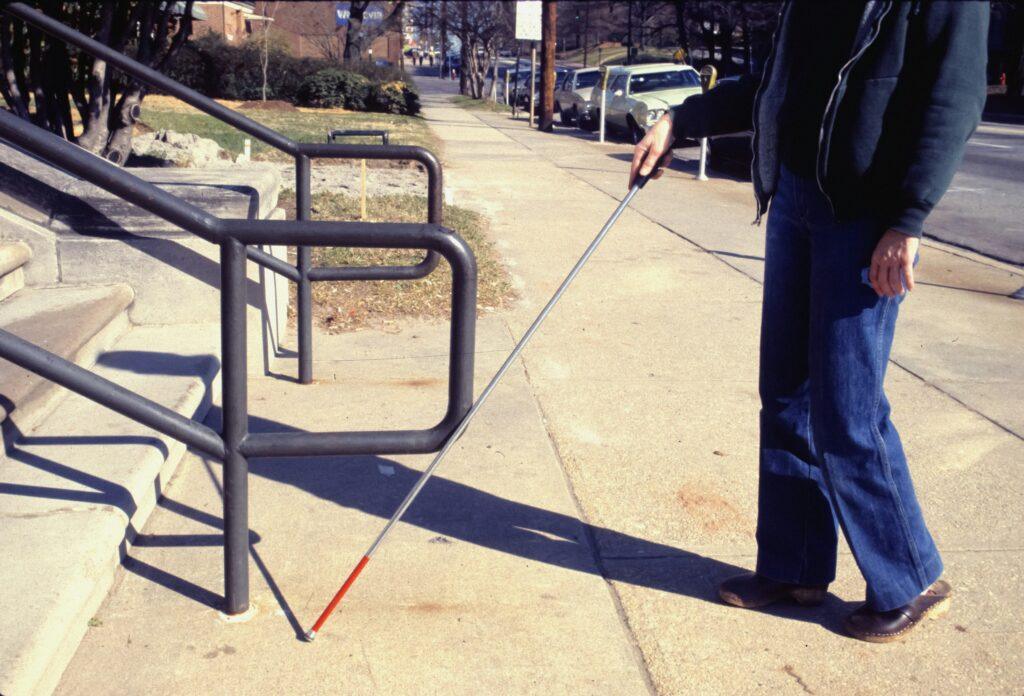
(Image Description: A person is shown from the mid-arm down, wearing a grey jacket and blue jeans, using a white cane while approaching a flight of stairs with grey metal railings. They are outdoors on a paved surface on a bright, sunny day, with cars parked along the side of the road.)
The following piece describes what it’s like to walk through the world with a white cane. It emphasizes that accessibility and inclusiveness helps EVERYONE. Enjoy the read!
As I walk through a park, a town, a mall or attend an event, one of the biggest barriers I face is silence.
I pass many people each day, yet very few speak to me. When my white cane is visible, people often do not know what to do or say. Silence feels safer to them. Stepping aside feels polite. Avoiding interaction feels easier than risking a mistake or feeling personal discomfort.
Many assume that being quiet as I pass is helpful. For me, it is not.
What is helpful is a simple hello. When you cannot make visual connections, silence can quickly turn into loneliness and isolation. Neither feels good.
One of my biggest pet peeves is when adults shush children as I approach. Curiosity is natural. Children notice differences and ask honest questions. When adults shut that down, they miss an opportunity to teach connection and instead teach avoidance.
When a child asks, “What is that?” or “Why is she doing that?” they are talking about my white cane. That moment is an invitation and I often take it.
I turn to the child and parent, say “hello I am Gina, I heard you are curious about what I am holding or doing.”
I explain that it is called a cane and it is white to let others know the person using it has low to no vision. I explain that silence is not helpful and that saying hello is like a smile I cannot see. It also opens the door for me to ask a question about my surroundings if I need to.
Sometimes I ask the child if they would like to touch my cane and I explain why it is important to always ask before touching a person or their mobility device. Two or three minutes of conversation can change how that child and that parent interact with the next person who is blind that they meet.
Another common experience is walking into a busy, chatty room and suddenly everything goes quiet. The energy shifts and conversations pause.
I am not contagious nor I am not a threat. I am simply someone using a cane to move safely through my environment.
People who are blind, have low vision or live with other disabilities are not as different as many assume. Our eyes, bodies or brain may work differently but the rest of us is the same.
We have hobbies, talents, jobs and go to school. We have children, pets, and families. We travel, try new things and some of us are adventurous. I do everything my sighted peers do, (except drive) sometimes I use different tools, technology, or alternative techniques. The outcome is the same, even if the path looks different.
Disability is not something to be afraid of. You cannot catch my blindness but you might gain a friend or an ally if you take the time to connect.
Uncomfortable conversations are necessary if we want to break down barriers created by assumptions, misconceptions, and lack of understanding. When we talk to each other and learn how to support one another, it takes the guesswork out and makes difference feel normal rather than awkward.
Many of us are advocating for accessibility because we need it to participate fully. Every person reading this will age. Bodies slow down,
aches and pains increase. Either Vision, Hearing, Memory, or Mobility change. Many people will also experience more than one of these at the same time.
Understanding accessibility, accommodations and inclusion now helps build a future where support is already in place when you need it.
Take time to get to know us as people, not as disabilities. When your own abilities change and they will, you will have much more to talk about than a new diagnosis.
Imagine a world where accessibility is simply part of everyday design. Where no one has to struggle just to participate. Where support is standard rather than requested.
Accessibility benefits everyone and it harms no one. Even when you do not need it, it quietly supports many. Accessibility creates a kinder, more connected society for all of us.
“Having a disability does not change who we are. It changes our interactions with the world.” – Gina Martin
https://www.DiverseAbilities.ca
ASSISTIVE TECHNOLOGY
Apple unveils new accessibility features, and updates powered by Apple Intelligence:
With Apple Intelligence, detailed descriptions and natural language navigation are coming to features such as VoiceOver, Magnifier, Voice Control, and Accessibility Reader
Now with Apple Intelligence, VoiceOver is more powerful than ever in helping users who are blind or have low vision explore their surroundings and onscreen images.
Last month, Apple previewed a suite of accessibility updates that use Apple Intelligence to bring new capabilities to features users rely on every day, including VoiceOver, Magnifier, Voice Control, and Accessibility Reader.
Apple also announced on-device generated subtitles for uncaptioned video content coming to the Apple ecosystem, as well as a new feature for Apple Vision Pro users to control compatible wheelchairs with their eyes. These new features, as well as updates using Apple Intelligence, are coming later this year. And starting today, the Hikawa Grip & Stand for iPhone — an adaptive MagSafe accessory designed with accessibility at the core — is available in three vibrant new colours on the Apple Store online.
“Apple’s approach to accessibility is unlike any other,” said Tim Cook, Apple’s CEO. “Now, with Apple Intelligence, we are bringing powerful new capabilities into our accessibility features while maintaining our foundational commitment to privacy by design.”
“The accessibility features our users rely on every day become even more powerful with Apple Intelligence,” said Sarah Herrlinger, Apple’s senior director of Global Accessibility Policy and Initiatives. “With these updates, we’re bringing new, intuitive options for input, exploration, and personalization — designed to protect users’ privacy at every step.”
VoiceOver and Magnifier Can Explore More:
For users who are blind or have low vision, VoiceOver and Magnifier can describe onscreen information or a user’s surroundings. With Apple Intelligence, these essential tools become even more powerful. The Image Explorer in VoiceOver uses Apple Intelligence to give more detailed descriptions of images systemwide, including what’s in photographs, scanned bills, personal records, and other visual content. With updates to Live Recognition, VoiceOver users can press the Action button on iPhone to quickly ask a question about what’s in the camera viewfinder and get a detailed response. Users can also ask follow-up questions in their own words to get more visual information.
Magnifier uses Apple Intelligence to bring the same assistive exploration and visual description to a high-contrast interface designed for users who have low vision. Magnifier also works with the Action button so users can quickly ask questions and get answers. And users can control the app itself with spoken requests, such as “zoom in” or “turn on flashlight.”
Apple Intelligence-powered updates to Magnifier bring the same assistive exploration and visual description to a high-contrast interface designed for users who have low vision.
Voice Control Gets Natural Language:
With Apple Intelligence, Voice Control becomes more intuitive than ever, using natural language to help users with a range of physical disabilities navigate iPhone and iPad entirely by voice. With a new flexible input, users can describe onscreen buttons and controls with natural language instead of memorizing exact labels or numbers.
The option to “say what you see” is great for navigating any app, including those with visual layouts such as Apple Maps or Files, using intuitive language like “tap the guide about best restaurants” or “tap the purple folder.” This can also help users overcome barriers when elements aren’t properly labelled for accessibility.
With Apple Intelligence, Voice Control becomes more intuitive than ever, using natural language to help users navigate apps and experiences.
Accessibility Reader Adapts Even More:
Accessibility Reader is a customized reading experience for users with a wide range of disabilities, from dyslexia to low vision, and with Apple Intelligence, the reading experience is more accessible than ever. Accessibility Reader works on more complex source material like scientific articles, handling text with multiple columns, images, and tables. On-demand summaries provide readers the option to get an overview of the article before diving into the details. And with new built-in translation, users can read text in their native language while retaining custom formatting, font, and colours.
Accessibility Reader works on more complex source material like scientific articles, handling text with multiple columns, images, and tables.