
This November 11th, we honour the veterans who have fought for our country.
From the President’s Desk
While we witness the changing colours of the leaves, and welcome frosty mornings and bid farewell to Halloween, it is a sign that November is upon us.
Following a truly outstanding World Sight Day Event, and kicking off our Author Series, along with our always popular Coast to Coast Bistro, the Council continues its valuable Committee work. Committees such as Membership, Advocacy, and newly formed Pharma add opportunity for Council members to participate, learn, and share ideas amongst each other, sharing valuable information between Provinces and Territories. Sub-committees such as Women of CCB and Men of CCB offer peer support and mentoring to participants in a confidential gender-based setting, offering expert speakers, and topical peer support.
While these committee-based activities offer ideas and discussion, they continue to be an open forum for Members to share ideas as well as a place to offer their expertise.
Members wishing to join said committees are welcome to contact our National Office for dates and times to join in these Monthly committee activities. Please bring your expertise, and knowledge as committees offer a setting to participate and learn about what is happening across Canada, in an area of your choice and any expertise you may have to offer is welcomed. Remember this is Your organization.
November 11th is Remembrance Day, a time to remember those who gave up their lives in combat to make Canada the great Country it has become today, so, if you can, please purchase a poppy to mark the occasion and show your support.
On behalf of the Board of Directors, Staff team, and many volunteers, the Council thanks you for your ongoing support, and please take the time to say thanks to our Veterans who gave up so much; and by purchasing a poppy and partaking in a moment of silence, it is a small tribute to what they accomplished.

(Image Description: A stone war memorial covered in bright red remembrance poppies, with dark metal sculpted leaves and a military helmet resting on its surface. Blurred figures and stone steps appear in the background.)
Please remember to get your eyes checked regularly.
Jim Tokos,
National President
MEMBER SPOTLIGHT
Finding Community, Independence, and Purpose: Derek Thompson’s Story:
For Derek Thompson, a member of the CCB Mississauga Chapter, living with vision loss has been a journey marked by resilience, community, and a commitment to helping others. Now 55 years old, Derek has been involved with the chapter for the past eight years, finding connection and friendship among people who understand his experiences firsthand.
Derek often describes vision loss as its own language.
“I have a belief that vision loss is a language,” he explains. “You need to connect with people who speak your language.”
That sense of belonging is one of the things he values most about the chapter. While work keeps him busy and limits how often he can attend, Derek enjoys joining the in-person gatherings and special events such as pub nights and movie nights. Members also connect regularly through weekly online meetings and evening social gatherings.
Derek’s vision loss began suddenly when he was just 14 years old. During the summer before starting high school, he noticed he was having increasing difficulty seeing things around the house. Within a short period of time, his life changed dramatically. Diagnosed with Leber’s Optic Atrophy, he lost his central vision.
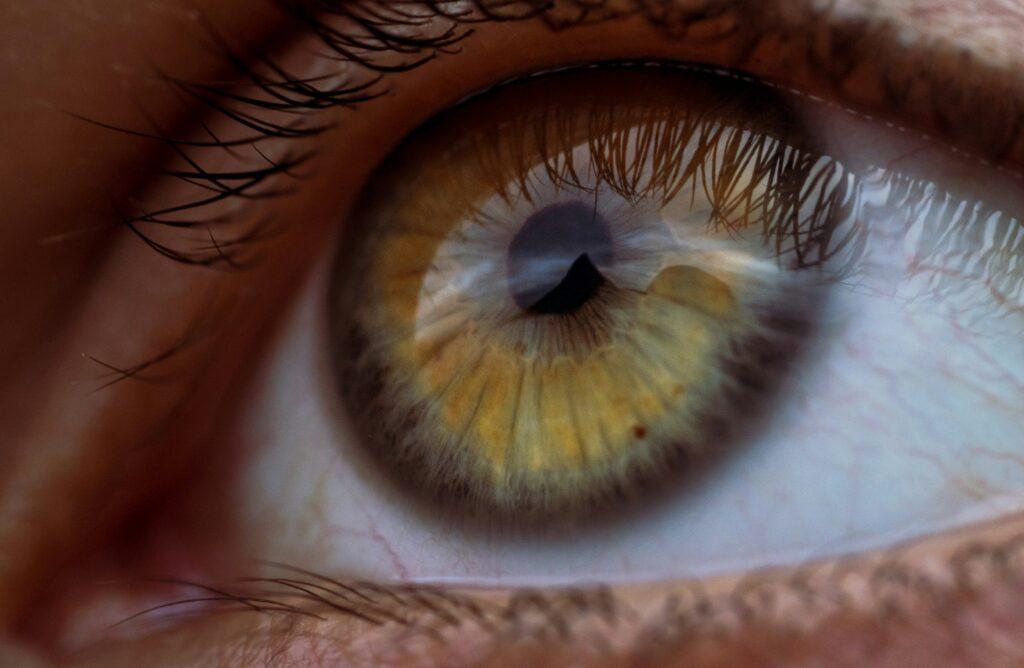
(Image Description: An extreme close-up of a human eye reveals intricate golden-green and brown patterns in the iris surrounding a dark pupil.)
“It was a huge transition at the time,” he recalls.
Despite those challenges, Derek developed a strong sense of independence. Today, he uses ZoomText software on his computer and continues to ride a bicycle confidently, which remains one of his primary ways of getting around.
His determination extends into his professional life. Derek works as a Child and Youth Care Practitioner, supporting students in high schools. Much of his work involves helping young people develop social skills, particularly students on the autism spectrum. He also provides crisis support for students experiencing difficulties or becoming involved in conflicts.
“It’s great because I get to connect with young people,” he says.
While inaccessible computer programs can sometimes create frustration, the rewards of the job far outweigh the challenges.
“What charges my battery is seeing kids succeed and grow.”
Having studied counselling, Derek brings a balance of compassion, empathy, and firmness to his work. He understands that supporting young people often requires both encouragement and clear boundaries.
Outside of work, Derek enjoys spending time with his family. He and his wife are avid card players who enjoy games such as euchre and poker. In local poker circles, Derek has become known as “the blind poker player.” To make the game accessible, the dealer reads the cards aloud to him.
“That’s my accommodation,” he says simply.
Derek and his wife have two children, a yellow Labrador retriever, and a busy household that keeps him active. He also enjoys going to the movies and finding ways to stay engaged in his community.
One of the most influential experiences in Derek’s life has been his long-standing connection to CNIB Lake Joseph Centre, commonly known as Lake Joe. For more than 40 years, the camp has played a significant role in shaping who he is today.
Over the years, Derek has attended as a camper, volunteered as a Counsellor-in-Training, worked as a staff member, served as a deafblind intervener, sat on the advisory board, and vacationed there with his family.
“It was a saving grace for me,” he says.
Lake Joe introduced him to other people living with vision loss and provided the peer support he needed during his formative years. It was there that he learned practical skills, gained confidence, and formed friendships that have lasted decades.
“People showed me how to do things. People I met in the 1980s I’m still friends with now.”
Reflecting on his experiences, Derek speaks with deep gratitude for the impact the camp has had on his life.
“I cannot say how much value and appreciation I have for Lake Joe. It fed my own independence, got my career started, and brought everything together. It got me focused on others, not just myself. It gave me great exposure to living independently and helped me develop life skills, both professionally and socially. They were life lessons.”
Today, Derek continues to draw upon those lessons as a husband, father, professional, and community member. Through his work, his involvement with the CCB, and his commitment to supporting others, he demonstrates that vision loss does not define what a person can achieve. Instead, it has helped shape a life built on connection, service, and independence.
ANNOUNCEMENTS
Self-Advocacy in Action – Standing Up for the Rights of Guide Dog Handlers:
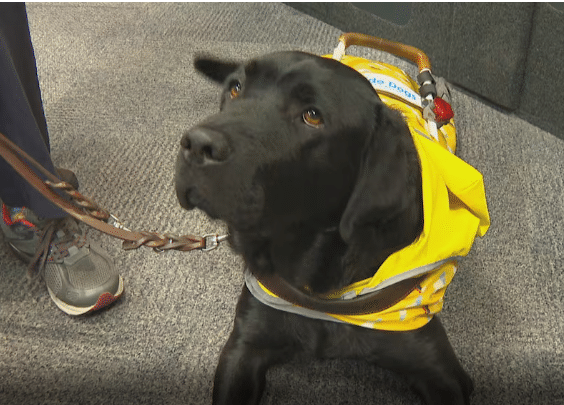
(Image Description: A photo of Monk, CCB’s Immediate Past President Louise Gillis’ black Labrador guide dog, lying on a gray carpet. Monk is wearing a bright yellow guide dog jacket and harness with reflective detailing. He looks attentively upward and has brown eyes. A brown leash extends toward Louise Gillis’ leg beside him.)
In September, Louise Gillis, Immediate Past President of the CCB, was repeatedly denied taxi service by City Wide Cabs in Sydney, Nova Scotia because she was travelling with her trained guide dog. Despite informing both the driver and dispatchers that refusing transportation to a person with a guide dog is against the law, she was told that no driver was willing to transport her. As a result, she was left stranded and nearly missed an important Accessibility Advisory Committee meeting.
With the assistance of a member of the public, Louise was able to reach her meeting. Later, when attempting to return home, she again faced significant delays and refusals before a taxi was finally provided. A municipal staff member witnessed the difficulties and remained with her until transportation arrived.
This incident highlights serious concerns about accessibility, equal access to transportation, and compliance with Nova Scotia laws that protect the rights of people who are blind and use guide dogs. Louise has brought this issue to the media and called for an investigation to determine whether the taxi company’s actions violated the Nova Scotia Blind Persons’ Rights Act and other transportation regulations.
Most importantly, this case demonstrates the value of self-advocacy. Louise repeatedly asserted her rights, documented what occurred, informed the appropriate authorities, and sought accountability rather than accepting discriminatory treatment. Her persistence helped bring attention to a broader accessibility issue that could affect other guide dog handlers. The incident shows that knowing and advocating for one’s rights is often essential to ensuring equal access and preventing barriers from going unchallenged. It also serves as a reminder of the importance of organizations such as the CCB, who engage members on the importance of self-advocacy, and provide peer support for members of the community who have experienced discrimination due to their disability.
The story was featured on CBC, and you can view the video at the following link:
https://www.cbc.ca/player/play/video/9.7373222
Join Women of CCB for our monthly virtual gathering!:

(Image Description: Three women stand closely together with their backs to the camera, raising their arms toward a colorful sunset. Warm orange and pink sunlight illuminates the sky above distant rooftops, while the friends wear casual clothing in shades of blue, white, and grey.)
This is a welcoming and supportive group for women experiencing sight loss to come together, share experiences, make connections, and enjoy meaningful conversations.
Our meetings take place on the second Tuesday of every month at 7:00 p.m. Eastern / 8:00 p.m. Atlantic via Zoom.
Each month, we enjoy different discussions, themed topics, and occasional guest speakers. Whether you are looking for friendship, support, or simply an opportunity to connect with other women who understand the challenges of sight loss, we would love to have you join us!
For those who are unable to access Zoom, a phone call-in option is also available.
If you would like to join our group or be added to our email list, please contact Heidi at hwhite@ccbnational.net.
Heidi and Leslie can’t wait to welcome you to the next Women of CCB gathering!
Join, Volunteer, or Support the CCB Toronto Ski Hawks Ski Club!:
The Toronto Ski Hawks is a recreational downhill ski club that pairs blind and vision-impaired skiers with fully sighted ski guides. Whether you’re an experienced skier or trying it for the first time, our friendly guides will meet you at your level.
We ski Saturdays from January to mid-March at private clubs north of Toronto, and volunteer drivers get you there and back. Best of all is the community: our days are full of laughter, encouragement and new friendships, on the hill and off.
The details:
- Membership: $30 for the year.
- Weekly fee: $30 for administrative costs.
- Lift tickets: Donated by our supporting ski clubs.
- Equipment: Rent or buy your own, with financial help available if needed.
We’d love to hear from you! Email info@torontoskihawks.org or visit www.torontoskihawks.org.
See you on the slopes!
Talha Sajun,
President, Toronto Ski Hawks
Come Join the CCB Men’s Group:

(Image Description: Six men sit together on cushioned outdoor patio furniture, smiling and chatting in a relaxed social setting. Each wear shirts in shades of blue, white, or grey. Tall green hedges surround the seating area, while a nearby metal drinks cart holds bottles, glasses, and an ice bucket.)
Members of the “Men of CCB” group would like to invite more individuals to join our monthly meetings, which take place on the 4th Tuesday of each month. The time for these meetings is:
– 8:30PM to 10:30 NLST, 7:00PM to 9:00 EST, and 4:00PM to 6:00 PST
Every month, we discuss a wide variety of topics. We find that our group is a “safe place” to bring concerns for which we are seeking solutions, as well as “support”. One of the more popular topics, for which 2 presentations were held earlier this year, dealt with “Balance, i.e., avoiding falls, and came to us from an Anatomy and Physiology Professor in Victoria, BC. All CCB members were invited to attend these very well-received sessions, and recordings of them may be received by contacting the CCB National Office.
Almost all of the input, regarding topics, comes from group members, and they are encouraged to do some research regarding resources which may be helpful in moving forward on these issues. For instance, one group member found Professor Panton, who presented on the topic of “Balance”, mentioned above.
If interested in joining our group, or would like more information, please contact our host, Jim Hamilton, at: jim.hamilton@rogers.com
We look forward to meeting you!
Early Bird Draw Winners Announced!:

(Image Description: Seven wooden letter tiles spell “REBATES” across a spread of colorful Canadian dollar bills, including visible $20 and $100 banknotes. A dark Canadian passport partially overlaps the currency in the upper-left corner.)
CCB National is pleased to announce that the two winners of the 2027 Early Bird Draw are the CCB Hamilton Chapter, Ontario, and the CCB York Region Lighthouse Chapter, Ontario. Congratulations!
Each of these chapters paid their chapter dues before the extended Early Bird Draw deadline and will be receiving back 100% of their dues to help support their chapter activities.
All other chapters who have paid thus far, as well as those who pay by the “Rebate” deadline of Friday, December 11, 2026, are still eligible for the Rebates of 50% of membership paid plus $1.00 per unduplicated email.
Please encourage your members who are paying individually via credit card, e-transfer or via the CCB website to do so before this deadline so that their payment can be credited to your chapter. Please also ask them to let someone in your chapter know that they have registered/renewed for 2027.
In any case, ALL 2027 membership dues are due by Thursday, December 31, 2026.
CCB National Membership Meeting – A Successful Discussion!:
The CCB National Membership Committee is pleased to share that the National Membership Meeting held on Monday, September 28, 2026, was a success! Thank you to everyone who attended and contributed to the discussion on sharing best practices, strengthening chapter programming, and growing CCB membership.
For those who were unable to attend, a recording of the meeting and a full transcript will be shared with members via CCB’s digital mailing list. Members may also request the recording link or transcript by contacting the National Membership Committee Chairs:
- Surander Singh: ssingh@ccbnational.net
- Heather Hannett: hhannett@ccbnational.net
Or, you may contact Olivia Nicholas, Office Manager at CCB National, at admin@ccbnational.net.
Your feedback and ideas are welcome!
We encourage members to share feedback, suggestions, and ideas for future discussions and initiatives. Those interested in joining the CCB National Membership Committee are also welcome to contact Surander Singh or Heather Hannett at their respective email addresses above.
Thank you again to everyone who participated. We look forward to continuing to work together to strengthen and grow CCB membership across the country!
Feel, Look, Tilt, Flip: Canada’s New $20 Bank Note Unveiled:
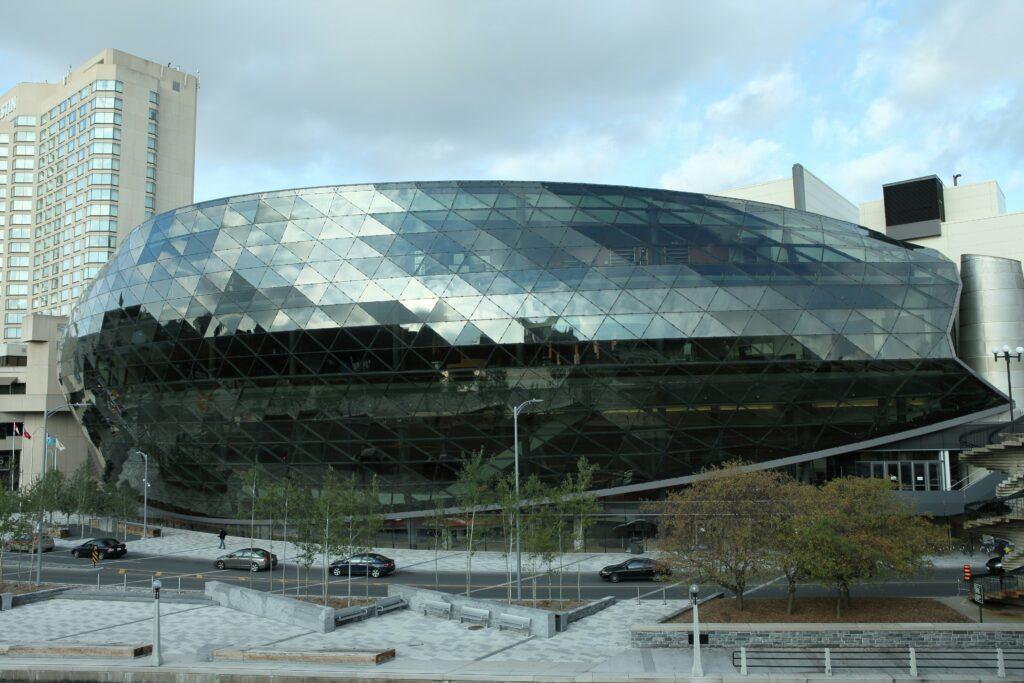
(Image Description: A photo of the Rogers Centre in Ottawa, Ontario. It’s a large, oval-shaped modern building with a reflective glass exterior composed of geometric triangular panels. The building is surrounded by city streets, trees, and buildings beneath a partly cloudy sky.)
On Thursday, September 3, dignitaries, members of the media, and stakeholder representatives gathered for a special ceremony celebrating the Bank of Canada’s unveiling of the new $20 bank note.
Held in the elegant Trillium Ballroom at the Rogers Centre in Ottawa, the presentation and reception offered a warm and welcoming atmosphere. Beautiful cups and saucers, thoughtfully arranged refreshments, and attention to detail added a touch of formality to the occasion. Every effort was made to ensure that guests, including people with disabilities, felt welcome and accommodated.
The ceremony was hosted by Maureen Carroll, Managing Director of the Bank of Canada’s Currency Department. Speakers included Tiff Macklem, Governor of the Bank of Canada; Her Excellency the Right Honourable Louise Arbour, Governor General of Canada; the Honourable Wayne Long, Secretary of State (Canada Revenue and Financial Institutions); and Elder Verna McGregor of the Kitigan Zibi Anishinabeg First Nation.
The new $20 bank note features His Majesty King Charles III on the front and the Canadian National Vimy Memorial on the back. It is the second note in Canada’s Vertical Series, following the introduction of the vertical $10 bank note featuring Viola Desmond in 2018.
Made of durable polymer, the new note is predominantly green, continuing the colour traditionally associated with Canadian $20 bills. One of its most distinctive features is a purple security stripe incorporating innovative technology. Carefully selected imagery celebrates important aspects of Canadian life, while large, high-contrast numbers make the note easier to identify.
The design combines visual appeal with practical features that help Canadians recognize and authenticate their money. As its slogan suggests, the process is simple: Feel. Look. Tilt. Flip. A video with detailed audio descriptions demonstrates how to check the note’s security features, including its distinctive texture, purple security stripe, and images that move or change when tilted. Together, these features make the note both beautiful and highly resistant to counterfeiting.
One of the most important aspects of the new bank note is its focus on accessibility. The design process began years before the unveiling, with input from a range of stakeholders to help ensure that the note would be usable by as many Canadians as possible.
Members of the Canadian Council of the Blind were invited to provide meaningful feedback. A small group of participants with varying levels of vision met with Bank of Canada representatives to share their experiences and perspectives on colour, contrast, texture, and ease of identification.
Their feedback covered many practical details, including the feel of the transparent window, the raised ink, the number and placement of braille cells, the visibility of images, and the usability of the security features. These considerations are particularly important because the $20 bank note is Canada’s most widely circulated denomination.
The goal was to understand how easily the note could be recognized and used by everyone, including people who are blind or have low vision. Participants’ suggestions, concerns, and positive comments were carefully recorded to help inform the design process.
This collaborative approach highlights the importance of involving people with lived experience in the development of accessible products. Thoughtful design can make everyday activities, such as handling cash, more convenient, independent, and inclusive.
The new $20 bank note is expected to enter circulation in early 2027. In the meantime, businesses and others who handle cash are preparing for its arrival. Public education will also play an important role in helping Canadians become familiar with the new design and its security features.
The unveiling marked an exciting step forward in Canadian currency design. By bringing together innovative security technology, distinctive Canadian imagery, and accessibility considerations, the new $20 bank note aims to help Canadians identify, authenticate, and use their money with confidence.
By Shelley Ann Morris.
The CCB Authors’ Series, Sponsored by AMI, has Begun!:

(Image Description: Capitalized text in dark blue and light blue reads, ‘CCB Authors’ Series.’ Below is a graphic of books lined up horizontally in shades of blue, grey, and black. Smaller text reads ‘Sponsored by,’ followed by AMI, with each letter displayed in a black box.)
This national webinar series highlights Canadian authors who are blind or living with vision loss. The series will bring together readers, writers, and members of the low-vision community for engaging conversations about authors’ books, creative processes, and lived experiences.
Confirmed Sessions:
- Lynn Jensen: Thursday, November 5 at 4:00 p.m. ET
- Penny Leclair: Monday, November 9 at 12:00 p.m. ET
- Anne Mok: Wednesday, November 18 at 12:00 p.m. ET
All sessions will take place on Zoom.
Please visit the link below to register now:
CCB Author’s Series Sponsored by AMI – Registration Form
IN THE NEWS
Visually impaired people fear smart glasses backlash:
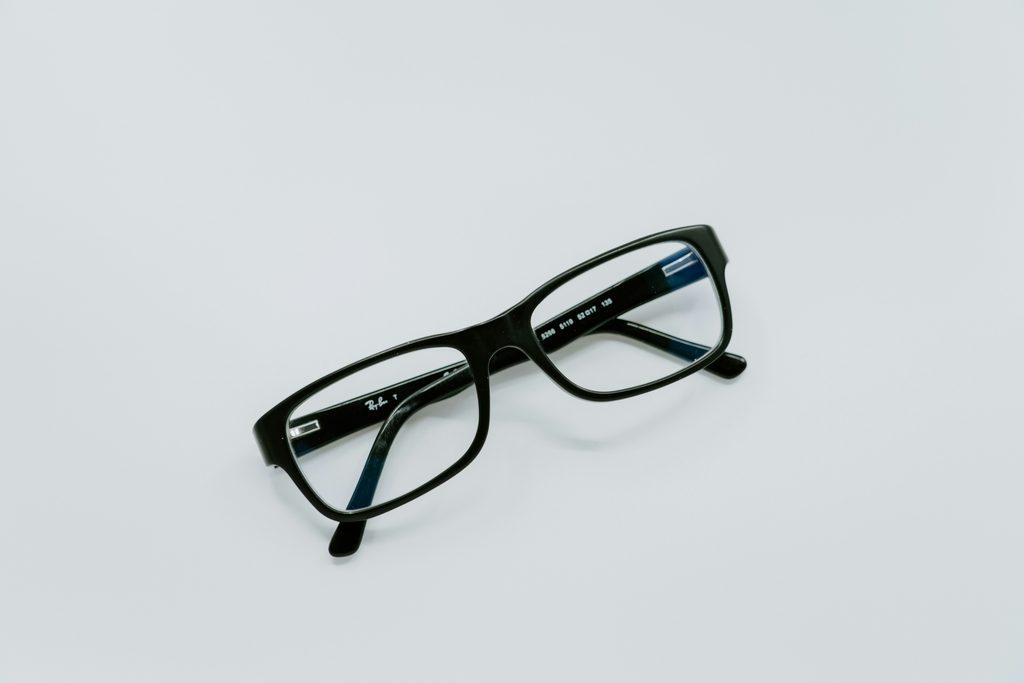
(Image Description: A pair of black rectangular Ray-Ban eyeglasses rests diagonally on a white surface. There is visible branding along the inner temple of the frames.)
Darren Paskell is visually impaired and uses smart glasses at home.
Sitting at his desk with some post in front of him, Darren Paskell puts on his glasses and says: “Hey Meta, read aloud all the text you can see on the letter.”
Within seconds a female voice reads the words on the page. For the past 18 months, Darren, who is visually impaired, has used smart glasses for tasks including sorting through post and reading labels.
“They’re really good for identifying different jars in the kitchen,” said Darren. “I’m in my 40s now and this is the first time that I’ve been in a position to wear something, talk to something and, with a single command, get the information that I’m looking for. This technology is absolutely life-changing for me.”
Darren, who works for the charity Guide Dogs, wears the glasses at home, but would like to use them more in public.
He said: “It would be great to have an idea what’s happening on the street while I’m walking down it, or where are the queues if I’m looking to buy something.”
However, a number of venues have restricted the use of the glasses, which have a tiny camera embedded in the frames.
The glasses are banned in courtrooms and some schools, as well as some pubs, restaurants, cinemas and theatres.
This followed concerns about their use. It can be difficult to tell when the camera is on, and some women have reported being secretly recorded by the devices and then harassed.
The glasses have a blinking white LED that switches on when the camera is active.
Exact sales figures are unknown, but Ray-Ban’s parent company EssilorLuxottica reported that it sold seven million pairs last year.
Meta, the company that owns WhatsApp, Facebook and Instagram, started selling smart glasses in 2021.
Other versions are in the pipeline and there are similar wearables being created by other companies.
Darren, who travels from his High Wycombe home in England to the office in Euston for work, said he was worried about how the backlash towards the technology could affect him.
“It is concerning for me when I’m not allowed to use them,” he said.
“That is essentially a little bit like an organization saying: ‘As a blind person, you’re not welcome coming into this place’,” he said.
Sight loss charities agree. Khadija Raza, the Royal National Institute of Blind People’s policy lead on accessibility, said the unintended consequence of organizations banning the devices could be that blind and partially sighted people “feel less safe and ultimately excluded from activities that others take for granted”.
‘Reasonable adjustment’
Khadija said the institute urged venues and service providers to take an “inclusive, proportionate approach” to the technology that protects privacy but also allows blind and partially sighted people to use smart glasses.
Rachel Taylor, technology Programme lead at the charity Guide Dogs, said she expected the number of people with sight loss who use smart glasses to increase.
“Guide Dogs call on businesses and venues to consider the use of AI wearables as a reasonable adjustment, recognizing the vital role these devices can offer,” she said.
But the stigma around the devices seems to be growing.
They have been nicknamed “pervert glasses” and were mocked in a series of unauthorized adverts and signs in London.
Stickers that were designed to look similar to Transport for London (TfL) safety notices were placed on the London Underground by activist group Everyone Hates Elon. The group also organized billboards that dubbed the devices “pervert technology”.
A spokesperson for the group said: “As a woman in London,
you feel really unsafe. The last thing we need is more things that help abusers to do things without our consent.
“That’s why these glasses are really scary, and we wanted to tell people about the risks of them and make them culturally unacceptable.”
They said the group wanted to shame people wearing the devices, adding: “We don’t want to be filmed all the time. I think you’re seeing a global pushback against a loss of privacy.”
TfL said unauthorized adverts that appeared on its network were removed as soon as they were identified.
The devices have been criticized as “pervert technology”.
Liz Hunter said she was so appalled by the glasses that she helped launch a petition and database called Stop Smart Glasses, which invites people to contact their local retailers and ask them not to sell the technology.
Liz said: “The government has not caught up; law hasn’t caught up with this.
“What we’re seeing is big tech racing ahead, again, of regulation. Now we’re in this awful mess where consent is supposedly an LED light in a pair of glasses. That is not consent.”
Liz added: “They’re being used for blackmail, for sextortion. They are an absolute infringement of our human rights. The general public is infinitely more at risk because of these devices.”
Filming people in public is generally legal, but it can still breach harassment or stalking laws, and filming people in places where they have a reasonable expectation of privacy may be unlawful.
A spokesperson for the Department for Science, Innovation and Technology said: “The government has no current plans to introduce specific legislation on the use of smart glasses for filming in public spaces because there are already criminal offences in place to deal with harmful conduct.”
Campaigners argue smart glasses have legitimate uses for people with visual impairments but should not be widely used in public.
A spokesperson for Everyone Hates Elon said: “Meta have some of the best technologists and brains in the world. So, let’s see them focus on helping disabled people, rather than trying to profit so much from our imagery, our voices and our data”.
Meta said its glasses provided valuable accessibility benefits for blind and other disabled users and could help users navigate their surroundings, access information and carry out everyday tasks more independently.
It has previously said that, as with any recording device, people using smart glasses should not engage in “harmful activities like harassment, infringing privacy rights, or capturing sensitive information”.
By Alison Earle, BBC News.