
From the President’s Desk
While the snow continues to slowly melt, and the temperatures begin to slowly rise, we are all looking forward to April to usher in warmer weather. I am sure I am not alone in saying goodbye to March, and looking forward to putting away the winter coats, gloves and boots. I won’t miss the many layers of clothing which cramp our daily routines!
Chapters across the Country continue to wrap up Winter sports and activities and are preparing for activity more conducive to warmer conditions.
From British Columbia to Newfoundland, Chapters continue to plan events and outings for their Membership. Chapters are planning outdoor sporting events such as lawn bowling, organized walking, swimming, outdoor concerts, theatre visits and friendly competition, like what is offered by the Atlantic Sports and Recreation Weekend in May. Many Chapters are also planning events over the summer months keeping health and fitness in mind.
I would be remiss if I did not mention the fine Committee work which continues such as Advocacy and Membership. Advocacy work such as advocating for the continuance of free postage for the blind, and key areas of transportation, all vital to our members across Canada are quickly acted upon if barriers are created. Advocacy never sleeps, and as persons living with vision loss, we must respond to any issues which arise on a timely basis.
April also brings us important opportunity to spend time with Family and Friends during Easter, a time to reflect on how fortunate we are to share food and camaraderie with our peers, and oh, let us not forget the Easter bunny!

(Description of picture: A basket holds several colorful and spotted Easter eggs surrounding a stuffed white bunny toy inside.)
On behalf of the Board of Directors, staff, sponsors, donors, and our many valued volunteers, we wish everyone a Very Happy Easter. I hope you can enjoy spending some time with Family and Friends. And please remember to get your eyes checked regularly.
Jim Tokos,
National President
MEMBER SPOTLIGHT
A Life in Rhythm and Resilience: The Story of Jim Noseworthy:
At 78 years old, Jim Noseworthy has lived a life defined by determination, curiosity, and an unwavering belief in the power of technology and community. Originally from Newfoundland and now settled in Fredericton, New Brunswick, Jim serves as a member at Large with the Canadian Council of the Blind (CCB). His journey, however, began long before his advocacy work—shaped by music, ingenuity, and a refusal to let barriers define him.
Born prematurely and totally blind since birth, Jim attended the Halifax School for the Blind. Like many young graduates, he left school without a clear plan. College didn’t interest him, but music did. It was more than a hobby—it was a calling.
Jim launched a career as a keyboard player and vocalist, performing everywhere from St. John’s to Toronto. Sometimes he played solo, other times with bands, always guided by his ear and instinct. Music carried him through those early years, but eventually he found himself exploring new paths.
He worked as a darkroom technician for a commercial film company and later took on various short-term government contracts. But a pivotal moment came when he tried to help his stepdaughter with her computer. He couldn’t access it independently, and the frustration struck a nerve.
Technology was becoming essential, yet blind people were being left behind.
That realization changed everything.
Jim began learning how to build computers. Around the same time, he read about a woman in California who had developed a speech program for blind users—distributed on a simple diskette. He bought the program, rented computers, and taught himself how to use it. “Blind people have no chance without technology,” he told his wife, and he meant it.
Armed with new skills, Jim visited the CNIB office in Fredericton. By coincidence—or perhaps fate—CNIB had just mandated the creation of Assistive Technology offices across the country. Jim already had the knowledge they needed. They hired him as an Assistive Technology Support Specialist, launching a career that would span more than three decades.
For 34 years, Jim supported clients from St. John’s to Vancouver. He even ran the first online teaching system for assistive technology, a program that operated for roughly 25 years. His dedication didn’t end at 5 p.m.—he was always willing to take calls, offering peer support whenever someone needed help.
Jim retired at 75, but retirement hasn’t slowed him down. Today, he’s returned to his first love: music. He performs as a keyboard vocalist in churches and often collaborates with Louise Burley, a friend he first met at the Halifax School for the Blind.
From musician to technician, mentor to advocate, Jim Noseworthy’s life is a testament to adaptability and passion. Whether on stage or behind a computer, he has spent a lifetime helping others find their voice—sometimes literally, sometimes through technology, always with heart.
ANNOUNCEMENTS
April Coast-to-Coast-to-Coast Bistro Night:

(Description of picture: Close-up of a vintage silver microphone with lights in the blurred background.)
It’s Back… and Better Than Ever! Join us for the next Coast-to-Coast-to-Coast Bistro Night!
Saturday, April 25th, 2026
7:30pm–9:30pm Atlantic
6:30pm–8:30pm Eastern
(Adjust for your time zone)
The Zoom room opens 15 minutes early, so pop in, get settled, and get ready for an evening full of connection and great vibes.
Just like before, we’ll kick things off with a warm meet-and-greet, then it’s all music, music, music!
Enjoy singing, piano, guitar, and a wonderful mix of English and French tunes, shared by talented performers from across the country.
Performers: Spots fill up quickly, so be sure to register early to secure your moment to shine!
Come join us to relax, listen, laugh, tap your feet, and enjoy the magic — all while sipping your favourite drink from the comfort of home.
To register or for more information:
Email Louise at lburley@ccbnational.net
Don’t miss it — an evening of music, connection, and coast-to-coast community awaits!
TandemEyes Cycling Club in Peterborough, Ontario – For the Love of Cycling:
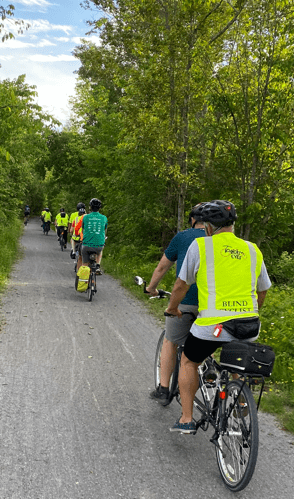
(Description of picture: Several tandem bikes riding along a quiet tree-lined gravel road.)
A common sight to see on a summer evening in Peterborough, Ontario, is a long line of tandem bicycles winding their way along local trails or city streets.
You might also hear happy sounds including multiple conversations, the occasional peal of laughter and the cheerful “ding” of a bike bell.
TandemEyes, a non-profit adult cycling club (under the umbrella of The Peterborough Cycling Club) makes it possible for visually impaired and blind cyclists to stay active and enjoy the company of fellow riders.
TandemEyes was founded in 2012 by Anne Wood, a lifetime cyclist who lost most of her vision to medical complications from cancer. Anne wanted to “bring activity and love of the outdoors to people with vision loss.”
Since the beginning, a dedicated group of volunteers have ensured that TandemEyes has continued and serviced our visually impaired community.
The TandemEyes season runs from May to August. Rides start from Millennium Park. Cycling routes range from 13-25 kilometers and involve a combination of roads and multi-use trails. The shorter distance rides are more common at season start up and as the cyclists build their riding legs and confidence – the ride distance increases.
The basic unit of a Tandem ride is the “captain” who sits in the front position controlling the steering, brakes and gearing, and the visually impaired “stoker” who helps provide the muscle and is also in charge of turn signals. All rides have a “leader” on a single bike at the front who leads the ride. Also included as part of the riding group is one or two “sweepers” who use their own bikes to assist with road crossings, keeping the line of riders together and help with any mechanical problems – i.e., flat tires.
Good communication on TandemEyes rides is imperative. Captains are constantly communicating with their Stoker to describe scenery, warn of upcoming bumps or turns, starts and stops. Sweepers are continually checking in with the Tandem bikes and Leader to be sure that everyone is comfortable on their bike.
If you live in the Peterborough area and are interested in being a stoker, leader, captain or sweeper as described above – please reach out to tandemeyes@gmail.com
To learn more about TandemEyes – go to our website at www.tandemeyes.com
Our upcoming season Orientation/Kick-off is Sunday April 19th at the Peterborough Holiday Inn at 10am.
Please RSVP to the email above if you plan to join us and learn more.
We would be happy to see you and answer any questions you may have.
Kintsugi Circus-This Montreal Circus is Making Performances Accessible to the Blind Community:
Forty visually impaired spectators were able to listen to an audio description of the circus show, Kintsugi. Circus group La TOHU teamed up with Danse-Cité to make the show more accessible by having two live audio narrators describe the scenes from a booth above the stage.
Watch the short video here:
https://www.cbc.ca/player/play/video/9.7102220

(Description of picture: The ceiling of a well-lit circus in red and yellow with the text “Circus Circus” above. Red and gold balloons can be seen in a circular shape on the ceiling inside.)
For All Lovers of Birds!:
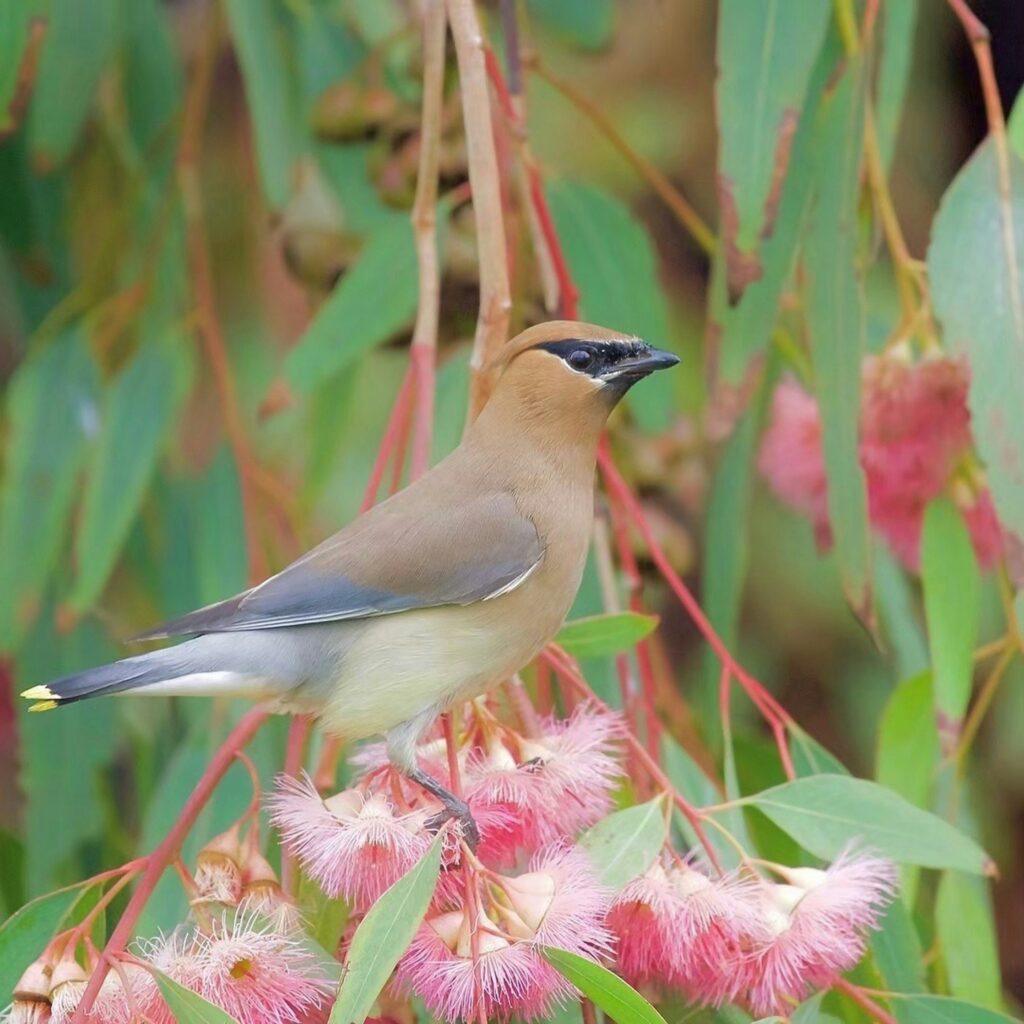
(Description of picture: Close-up of a cedar waxwing bird, whose wings are a light brown to grey gradient, standing on a eucalyptus tree with pink flowers during the day.)
Did you know that there are many opportunities for birding by ear for people who are blind or have low vision?
If you are not already enjoying birding by ear, we would like to encourage you to begin. It’s a great way to connect to the natural world.
Here are some ideas on how you can begin or improve your birding by ear skills.
1. Check out the Birdability website, which has a lot of great resources.
- If your local blind and low-vision community already has access to birding-by-ear events, that’s fantastic! We’d love to hear about it; please let us know at steve@torontobirding.ca
- Otherwise, depending on the size of your community, there may be one or more birding groups that organize outings for birders in general, and they might be able to help you find good birding locations that meet your transportation and accessibility needs. They might even have some birders who could join you and help you identify birds by ear, if you’re new to this. We would encourage you to reach out to local birders and let them know that you are interested in learning to bird by ear.
- Google is probably your best bet for finding birding groups or individuals that organize walks in your community.
2. On May 3 and 4, 2026, you can participate in the Blind Birder Birdathon.
- The idea is to get out and find as many birds by ear as you can. Details of the event including a registration link can be found at the Birdability site. Click here: https://www.birdability.org/blind-birdathon
- The Toronto Ornithological Club (TOC) will be involved in this event in Toronto, and we are also undertaking to promote it nationally across Canada.
- We encourage you to organize a group of blind and low vision birders, or you can participate in the Birdathon on your own – just register on the Birdability site.
- And we will be advertising this event to birding groups across Canada so you may find a local birding group that is organizing something for this event.
If you have any questions or anything you’d like to share, please contact us at:
steve@torontobirding.ca
ASSISTIVE TECHNOLOGY
Understanding Be My AI–How It Works—and What It Does (and Doesn’t Do):
(Description of picture: The letters “AI” are shown in shades of blue, pink, and purple with wavy lines on the left with a light blue, pink, and white gradient background.)
Imagine snapping a photo and having it explained to you instantly in clear, natural language. That’s exactly what Be My AI, a feature inside the Be My Eyes app, does for people who are blind or have low vision. What the sighted world takes in through their eyes, the vision-loss community can now access through words.
For people who have never had sight, Be My AI gives access to information they may never have been able to experience before. For people with low vision, it fills in the gaps—providing details that sighted people often absorb without thinking. And for those whose vision is decreasing over time, Be My AI offers a way to stay connected to the visual world, from recognizing changes in their surroundings to hearing descriptions of loved ones’ faces.
Baby pictures are no longer just blobs and blurry shapes wrapped in blankets—they become meaningful moments. Users can match clothes, check their appearance by taking a selfie, to get that “last look in the mirror” before heading out the door. For someone tracking fitness or weight-loss progress, it can be another helpful way to notice changes over time. For many people, it’s nothing short of a game-changer.
Turning Images Into Understanding
At its core, Be My AI translates visual information into language. A blind or low-vision user takes a photo, and the AI returns a detailed description of what’s in the image. That image might be a document, a product label, a room, a sign, a person, or an everyday situation.
What makes Be My AI especially powerful is that it’s interactive. Users can ask follow-up questions such as:
- “Which button should I press?”
- “What does this label warn me about?”
This isn’t just about identifying objects—it’s about understanding context and making informed decisions independently. That can be critical for safety, too. Tiny print on medication bottles may no longer be a barrier, and important warnings like “may contain nuts” are made accessible, necessary when preparing food for someone with severe allergies.
Faces, Privacy, and What the AI Does Not Do
A common concern is how AI handles photos of people—especially faces. This is where it’s important to understand the difference between facial recognition and facial description.
Facial recognition identifies who someone is.
Facial description explains what someone looks like.
Be My AI does not identify people or match faces to names or databases. Instead, it offers general descriptions—such as clothing, expressions, or visible features—without saying who the person is. This distinction is intentional and helps protect privacy.
Another frequent question is what happens to photos after they’re taken. When an image is submitted, it’s securely sent to cloud servers so the AI can generate a description. According to Be My Eyes’ published privacy information, these images are not used to train AI models, and AI providers are not allowed to use them for training either. The photos are processed to create a response, not stored as part of a public image library.
As with any photo-based technology, users are encouraged to ask permission before photographing people and to avoid sharing sensitive information unless it’s necessary—such as in a medical situation where understanding that situation could help to determine whether an emergency room visit is needed. This can be especially valuable for blind parents or caregivers.
Descriptions That Build Connection
Descriptions of people are factual, not judgmental. Phrases like “older person” or “dark-skinned” are simply pieces of visual information—details that sighted people notice automatically. As descriptions have become more nuanced, users can hear about facial expressions, clothing, and actions. These details help bridge social gaps: “Oh, I didn’t know you had a tattoo.” “Cool shirt….Swim, bike, run—are you a triathlete? So am I” Moments like these allow people with sight loss to connect with others in the same natural, effortless way sighted people do every day.
Seeing the Bigger Picture—Even With a Small Field of Vision
For users with limited fields of vision, such as tunnel vision, Be My AI’s scene descriptions are especially meaningful. Instead of missing what’s happening outside a narrow visual window, users can hear about the broader environment—details others might catch with a quick glance around a room.
This can enrich everyday life as well as special experiences. Familiar spaces feel fuller. New places become easier to explore. Even vacation photos gain new depth—sometimes with unexpected humor, like discovering a “Dead End” sign spotted on a road trip outside a cemetery.
Independence, Clarity, and Confidence
For many users, Be My AI represents the difference between guessing and knowing, between needing assistance and acting independently. It provides clarity, confidence, and a richer understanding of the world for people who are blind, have low vision, or are losing sight over time.
Ultimately, Be My AI isn’t about surveillance or identification. It’s about access, dignity, and independence—turning visual information into language so people can understand, navigate, and engage with the world around them safely and responsibly.
Submitted by Shelley Ann Morris
IN THE NEWS
A blind dad from the U.K. has left internet users in awe after revealing how he distinguishes between his 3-month-old twins:
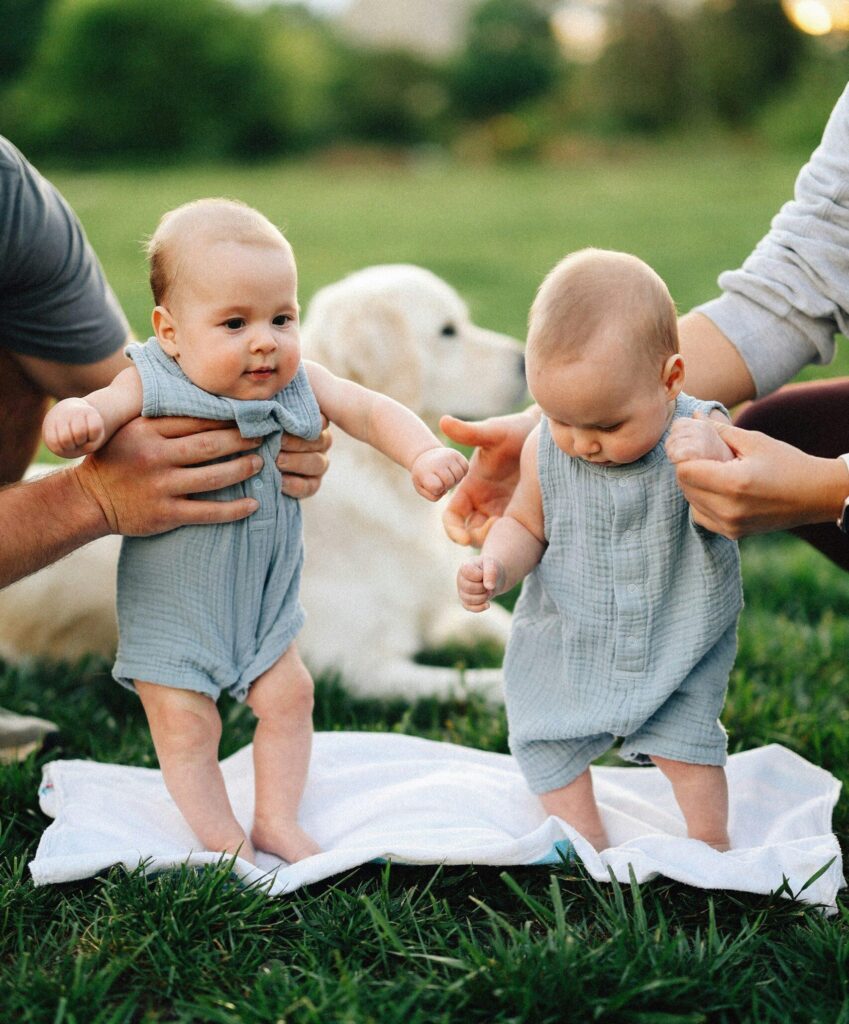
(Description of picture: Two babies wearing matching light blue short onesies are being held upwards on their feet by their parents on a white blanket above grass. A beige dog can be seen in the blurred background.)
Souleyman Bah (@blinddaduk) shared a reel on Instagram answering a question he’s heard since welcoming twins Angelo and Nemaya with his partner Saskia Symington: “How is it that a blind dad like me can tell between these twins?”
Souleyman, who has around 10 percent of his eyesight, explained that the answer wasn’t always obvious.
In the blurred, sleep-deprived days after the twins were born, exhaustion and emotion took over as he adjusted to life with two newborns on top of caring for the couple’s 2-year-old daughter, Tallulah-Bella.
Like many new parents, he worried about getting things wrong, but layered over that was anxiety about mixing the twins up or missing something important.
“Those thoughts definitely crept in during the quiet moments,” Souleyman told Newsweek. “At the same time, I didn’t want my sight loss to be the thing that defined how I showed up as a dad.”
“I had to trust myself and learn as I went,” he continued. “Pretty quickly, I realized that being a parent isn’t just about what you can see, it’s about being there, getting to know your children, and building that connection day by day.”
At first, the dad of three recognized that each baby had a distinct cry—Nemaya’s higher-pitched and quick, Angelo’s more drawn-out.
As the weeks passed, their sizes began to vary slightly. Their hair grew in differently, Angelo’s lighter and Nemaya’s darker and curlier.
Soon enough, the babies’ personalities shone through. One is much calmer and more settled, while the other is louder and more expressive.
“The way they breathe when they’re asleep is different, and even how they relax when you hold them isn’t the same,” Souleyman said. “Those little things are what I rely on. It’s shown me that you don’t need sight to know who someone is—you can feel it.”
Practical strategies also play a role. Souleyman keeps a mental map of where each baby has been placed—one in the cot, the other in the SnuzPod—relying on routine rather than guesswork.
His reel has gone viral on Instagram, clocking up 734,000 views. In the comments, users were thoroughly impressed by the dad’s ability.
“Such beautiful babies. It’s so fascinating that you are able to tell which is which,” one user wrote.
“Present and active dad. No one has an excuse,” another added.
Although many responses came from surprise, even disbelief, that a blind parent could confidently and safely care for young children, Souleyman felt the reaction missed the point.
“I wish people understood that blindness doesn’t mean helplessness,” he said. “What people often don’t see is the adaptability, problem solving and heightened awareness that comes with vision loss. We don’t parent despite our disability we parent with it—and our children grow up seeing resilience, creativity, and independence modeled every day.”
How do visually impaired athletes compete at the Winter Paralympics?:
Editor’s note: Now that the Paralympics are over, we thought some of you might be curious as to just how those athletes accomplished those amazing athletic feats! Read on to learn how they did it:
Three of the six sports at the 2026 Winter Paralympics feature visual-impairment categorizations, including Para-Alpine skiing, Para-cross-country skiing and Para-biathlon.
Those sports are split into standing, sitting and visually impaired categories.
Para-Alpine skiing is split into five disciplines – downhill, slalom, giant slalom, super-G, Alpine combined and team events – with visually impaired athletes using a sighted guide to help them navigate the slopes.
Para-biathlon combines cross-country skiing and rifle shooting and is adapted for visually impaired athletes with the use of an electronic gun rather than a scoped rifle.
Para-cross-country skiing, meanwhile, involves racing over undulating terrain along a series of prepared tracks.
Visually impaired athletes also compete with a guide in cross-country skiing and biathlon.
How do athletes communicate with their guides?
Athletes use a specially adapted bluetooth helmet to communicate with their guides.
Skiers are directed through the course by their guide, who gives verbal signals to indicate the direction the athlete should go.
The guide talks to their partner using a Bluetooth microphone and headphone communication system built into their helmet.
They are responsible for communicating the direction of travel, changes in terrain and snow conditions, and providing updates on the rhythm of the course.
The athlete and guide must remain less than three gates apart in slalom and less than two apart for giant slalom, super-G and downhill.
Spectators are also asked to be quiet during races so athletes can hear their guides.
How do visually impaired athletes shoot in biathlon?
Visually impaired biathletes use an electronic rifle guided by acoustic signals to find the target
In Para-biathlon, athletes race different distances around the looped course, and between laps stop and pick up their rifles at the shooting range.
They must hit five targets, and for each missed shot, competitors either get a time penalty or must ski a penalty loop, depending on the event.
Visually impaired athletes use an electronic rifle guided by acoustic signals.
When their gun is aimed at the target, the equipment emits a high-pitched tone through their headphones. The higher the sound of the tone, the more precisely the athlete is aiming at the centre of the target.
How are classifications decided?
Athletes go through a formal process to determine whether or not their impairment makes them eligible to compete at the Games. Once they are deemed to meet the minimum impairment criteria (MIC), athletes are assigned a classification to ensure they compete against opponents of similar or equal impairment.
The International Paralympic Committee classifies an athlete as visually impaired if they have reduced or no vision caused by damage to the eye structure, optical nerves or optical pathways, or visual cortex of the brain.
At the Winter Paralympics, athletes with varying degrees of visual impairment compete in the same classification.
To compensate, the disciplines use a system called factored time, which means the clock speed changes depending on their sub-categorisation. When British skier Menna Fitzpatrick competed in the super-G in 2022, for example, she had a factored time of 87.24%, meaning the clock moved slightly slower than a standard second.
Do guides get a medal?
Yes, guides do also receive a medal if their athlete earns a spot on the podium.
Canada’s Kalle Eriksson, Guide Sierra Smith Earn Slalom Bronze for Third Medal of Paralympic Debut:
Duo also took downhill silver, super-G bronze in men’s visually impaired category.
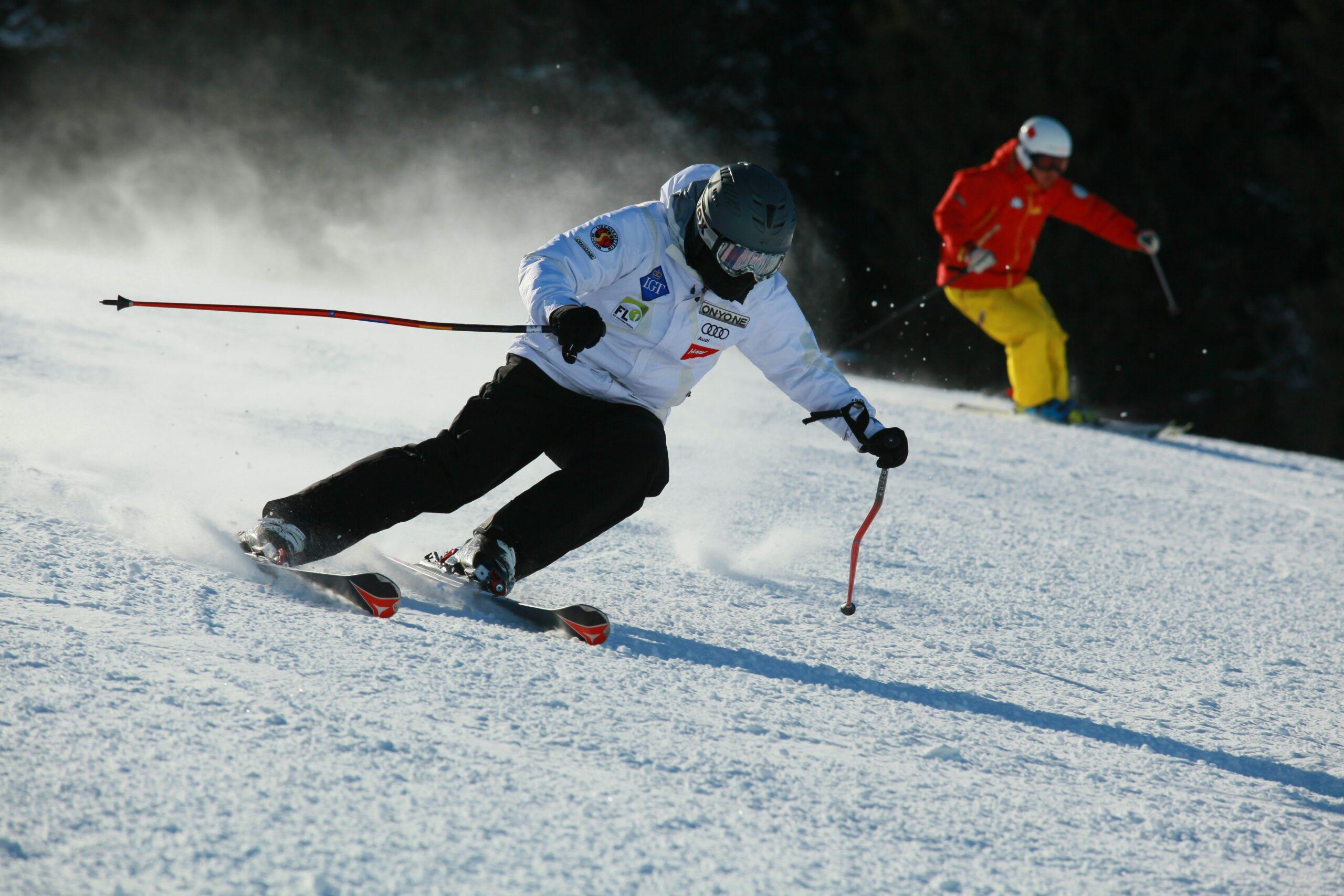
(Description of picture: A skier in a white jacket and black snow pants carves sharply down a snowy slope while another skier in a red jacket and yellow snow pants follows in the background.)
Canadian Para alpine skier Kalle Eriksson and guide Sierra Smith capped their memorable Paralympic debut with bronze in the men’s visually impaired slalom at the Milano-Cortina Games.
Eriksson, from Kimberley, B.C., and Ottawa’s Smith, clocked a total time of one minute 31.26 seconds across two runs at the Tofane Alpine Skiing Centre in Cortina d’Ampezzo, Italy. Both of their runs ranked third among the 13 skiers who finished the event.
Italy’s Giacomo Bertagnolli and Andrea Ravelli won their second gold and fifth medal overall of these Games with a total time of 1:29.29, ahead of silver medallists Michal Golas and Kacper Walas of Poland by 0.27 seconds.
Eriksson and Smith, who are also partners, won Canada’s first medal of the Games with silver in the downhill event before adding bronze in the super-G.
Their latest medal brought a sense of relief for Eriksson, who missed the podium by one spot in the last two events — the alpine combined and giant slalom.
“I’m feeling great right now,” Eriksson said. “To finally get back on the podium is awesome. We missed it twice just by a hair. I was definitely a little worried.
“My ambition for today was to just go out and have fun, but then the second run came around, and I was in third again. I was like, ‘Man, I really do not feel like coming fourth again,’ so to come down across the bottom, and go first and finish third was awesome.”
The Canadian duo began competing together in 2022. They won silver medals in the slalom and giant slalom at last year’s world championships and have earned 22 career World Cup medals across three seasons.
They communicate through a headset and do a variety of sports and activities outside of skiing to help them perform as a singular unit on the snow.
“It may be against Kalle’s will, but I drag him out line dancing,” Smith said. “Not that I’m very good, but just trying to teach each other and work together line dancing is nice because if we’re just going to step the wrong way, we will bump into each other.
“All those little things — mountain biking, rock climbing, all sorts of things to work on our communication.”
CBC News