
From the President’s Desk
Welcome to National Accessibility Week (May 31 through June 6).
While recently visiting Chapters and Members from British Columbia to Newfoundland, I witnessed the creativity evident in the ongoing efforts of all to continue to strengthen the scope of the Council.
We are indebted to the many Council leaders who continue to ensure members involve themselves with programs and events which may be unique to their geographical areas and continue to think of accessibility while offering these programs. It is evident through our National Membership Committee that members share programming ideas which improve our offerings to our membership across the Country.
The landscape of the Council is also blessed with the many who continue to advocate, albeit at differing levels, Municipal, Provincial and Federal. All advocacy work is necessary, as we as members living with vision loss offer lived experience when advocating to these many forms of Government. A simple item such as an accessible crossing signal (ACS) within Communities, is so important, and the expertise we carry to educate and advocate for white canes and guide dogs, policy change and our presence on Government committees all weigh in on an accessible environment free of barriers, which is front and center to the safety of ourselves and our constituents.
The CCB is also blessed with a strong unified National Advocacy Committee made up of membership and leadership from across Canada. The work of the advocacy committee has continued to stress the importance of the many barriers currently in place, which we as people with lived experience, must bring to the attention of elected officials within our communities. This is an example of self-advocacy, and I continue to hear from members who find barriers in their communities and urge them to bring it to the attention of their elected officials.
We continue our work with our many partners and sponsors to move the National Eye Care Strategy forward. The Council officially launched the Right to Sight campaign at its recent National Vision Month gala.
I ask everyone to please read the reports included in the AGM packages recently distributed for our June 24th Annual General Meeting, and please join us for further updates.
Father’s Day is on Sunday, June 21st, and we at the Council recognize and celebrate fathers, grandfathers, and father figures everywhere.
On behalf of the National Board, staff team, sponsors, donors, and many volunteers, we thank everyone for their continued support. Please ensure you get your eyes checked.
Jim Tokos,
National President

(Description of image: Wooden scrabble pieces read “Happy Father’s Day” against a wooden table.)
MEMBER SPOTLIGHT
Mary Campbell: Athlete, Volunteer, Musician, and Community Leader:
Mary Campbell of Sydney, Nova Scotia, is a vibrant, long‑time community member whose life reflects resilience, dedication, and a deep love of sport, music, and service. Born prematurely and exposed to too much oxygen at birth, Mary became blind early in life. She attended the Halifax School for the Blind, where she learned braille, how to use a white cane, and the independent living skills that helped shape her confidence and self‑reliance.
After graduating, Mary returned home and joined the Canadian Council of the Blind (CCB) in Sydney in 1992. More than 30 years later, she remains an active and valued member of the CCB Sydney Chapter. Through the CCB, she found community, purpose, and opportunities to stay active, something she prioritizes in every part of her life.
A Champion in Blind Curling
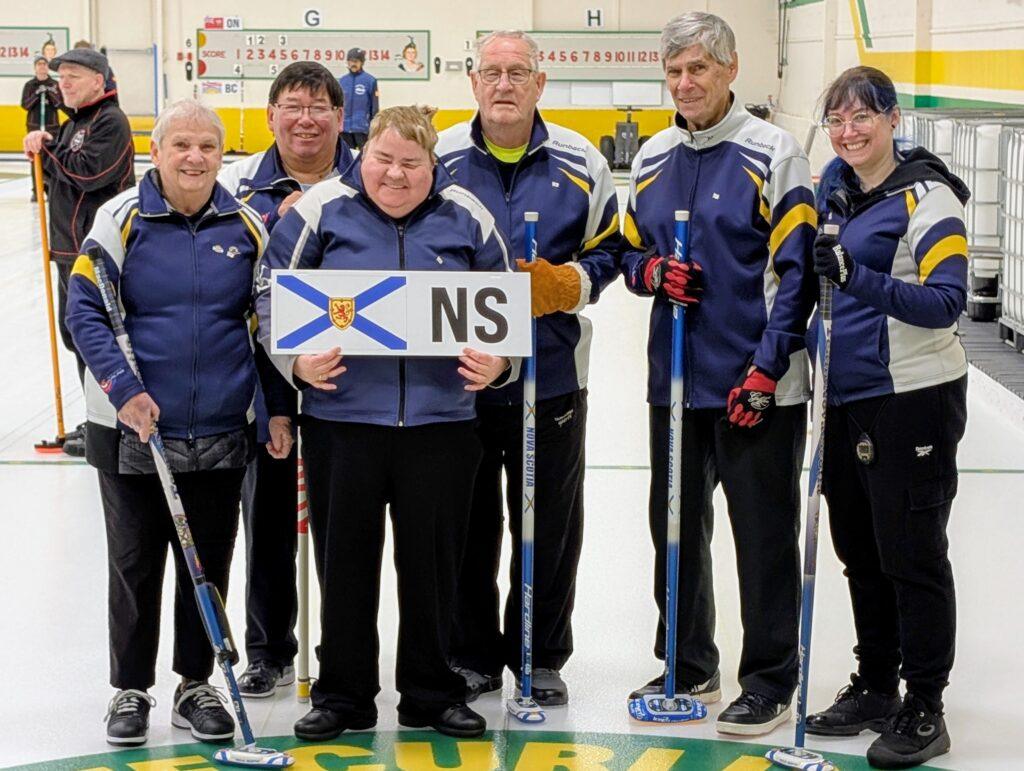
(Description of image: Mary Campbell stands on the left holding a sign with the Nova Scotia flag. She is joined by Team Nova Scotia teammates Louise Gillis, Jim Simmons, Mike Vrooman, Amanda MacAulay, and Sidney Francis at the Granite Curling Club in Edmonton, Alberta. The group smiles for the camera, wearing matching navy, white, and yellow team jackets.)
Mary is a dedicated blind curler who has represented her region proudly at the Canadian Vision Impaired Curling Championship in Ottawa. Her team’s achievements speak for themselves: In 2019, her team brought home the Gold Medal; in 2020, a Silver Medal and this past year in 2026 in Edmonton, they won a Bronze Medal.
This past season, Mary curled twice a week, continuing to sharpen her skills and enjoy the camaraderie of the sport.
A Fixture of Atlantic Sports and Recreation Weekend
Mary has been involved with the Atlantic Sports and Recreation Weekend (ASRW) for many years, competing in multiple events and always bringing her enthusiasm with her. This year, she returned home with six ribbons and medals, including recognition for her singing in the CCB Blind Idol competition.
Active in Many Sports and Hobbies
Beyond curling, Mary also participates in blind bowling and keeps herself active through walking and community events. Her hobbies reflect her creative and social spirit and include singing and playing guitar and piano, reading books, spending time on Facebook catching up with friends and enjoying walks outdoors.
Music is a big part of her life—she sings for fun and loves performing whenever she gets the chance.
A Dedicated Volunteer
Once a week, Mary volunteers at the Cape Breton SPCA, where she works with animals and finds the experience deeply rewarding. Her compassion and patience make her a natural fit for the role, and she looks forward to every visit.
Career Journey
After joining the CCB in 1992, Mary worked hard to find employment, though opportunities were limited. She completed the Employment Development Program to build her skills and explore new possibilities. Despite the challenges, she has continued to stay active, engaged, and committed to contributing to her community.
ANNOUNCEMENTS
Atlantic Sports and Recreation Weekend Recap:
The 2026 Atlantic Sports and Recreation Weekend (ASRW), hosted in St. John’s, Newfoundland, and Labrador from May 15–17, brought together members of the blind and visually impaired community from across Atlantic Canada for a weekend filled with sports, recreation, friendship, and community spirit.
Hosted by the CCB and organized locally by the CCB St. John’s Royles Chapter, the event proved to be a tremendous success and highlighted the dedication and teamwork that make gatherings such as ASRW so meaningful.
Participants arrived throughout Friday afternoon and evening, gathering at the Capital Hotel for registration, a meet- and- greet, crafts display, CCB Idol, and an evening jam session that immediately set a warm and welcoming tone for the weekend. Attendees had the opportunity to reconnect with longtime friends while welcoming new participants into the ASRW family.
Saturday featured a full day of athletic competition and recreational activities. Bowlers travelled to Paradise Bowl for two games of 5-pin bowling, including both regular and chute bowling. Following lunch, participants competed in track and field events at the Fortis Canada Games Complex before wrapping up the afternoon with swimming activities at the Aqua Arena. The Annual General Meeting was also held Saturday evening before participants gathered once again for a lively dance featuring music provided by local DJ Shane Cashin. The dance and social atmosphere throughout the weekend reflected the strong sense of friendship and inclusion that defines ASRW.
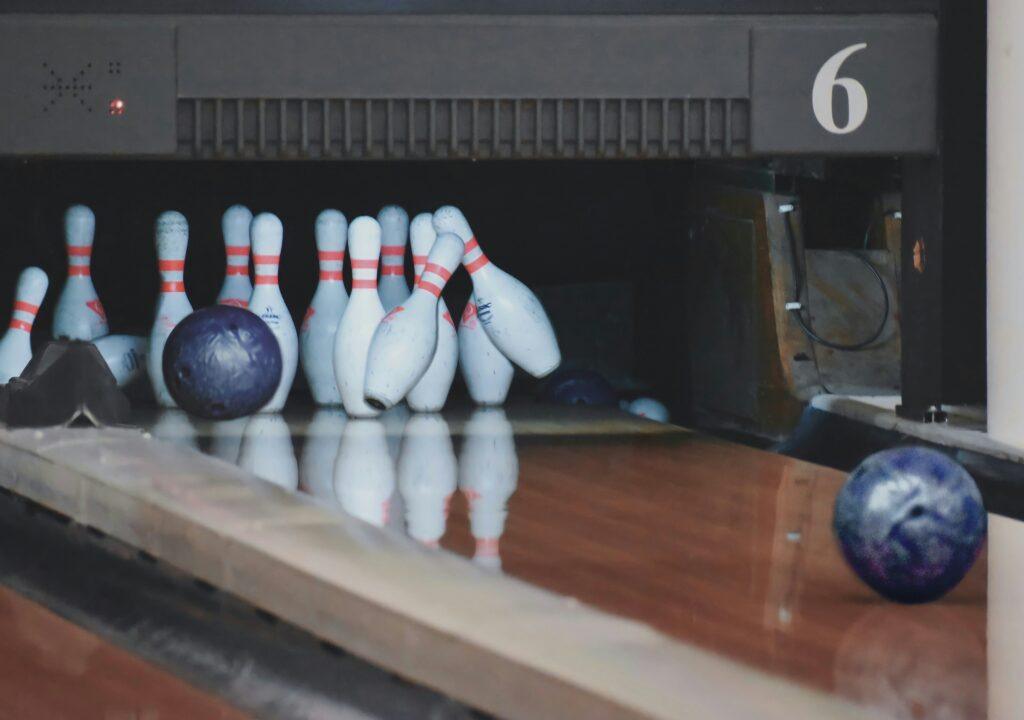
(Description of image: Close-up of a navy blue bowling ball striking a set of pins, with another bowling ball visible on the right.)
Sunday’s activities included table bowling, darts, and a cribbage tournament before the weekend concluded with the banquet and awards ceremony. The banquet provided an opportunity to recognize participants, volunteers, organizers, and supporters who helped make the weekend possible. The event was especially honoured by the attendance of Jim Tokos, whose presence underscored the importance of the ASRW within the broader CCB community.
During the banquet festivities, the CCB St. John’s Royles Chapter was also pleased to honour longtime club secretary Elena Giovanni with a Lifetime Membership in recognition of her years of dedication, service, and commitment to the chapter and its members. The presentation was a meaningful moment during the weekend and was warmly received by those in attendance.
The success of ASRW 2026 was made possible through the hard work of the local Host Planning Committee, chaired by Lori Shea, and supported by committee members Karen Young, Chair of the CCB St. John’s Royles Chapter, Glenda Brown, Shane Cashin, and Past District Governor Brad Moss representing the Portugal Cove- St. Philip’s Lions Club. Countless volunteers also gave their time throughout the weekend assisting with transportation, registration, setup, guiding, food service, and event coordination.
Special appreciation is extended to the many Lions Clubs, businesses, organizations, and individuals throughout the St. John’s area whose generous community support helped ensure the success of the weekend. Their contributions demonstrated the tremendous community spirit that Newfoundland and Labrador are known for, and helped create an atmosphere where participants felt welcomed, supported, and celebrated.
Beyond the competitions and scheduled events, ASRW 2026 once again demonstrated the importance of recreation, inclusion, and social connection within the blind and visually impaired community. As participants departed for home following the final jam session Sunday evening, many were already looking forward to gathering again next year in beautiful Charlottetown, Prince Edward Island, with friends who, through weekends like these, have become like family.
2026 Annual General Meeting:
The Canadian Council of the Blind Annual General Meeting will be held on Wednesday, June 24, 2026 at 12:00 p.m. EDT via Zoom Webinar, with voting available online.
AGM notices, supporting documents, and ballot information were distributed to all eligible Class A members via electronic and postal mail.
If you require additional information or did not receive the official notice and documents, please contact the National Office at ccb@ccbnational.net, or reach us by phone at 613-567-0311 or our toll-free line 1-877-304-0968.
Vision Health Month Conference 2026 Pan-Canadian Voices: Recording Available!:
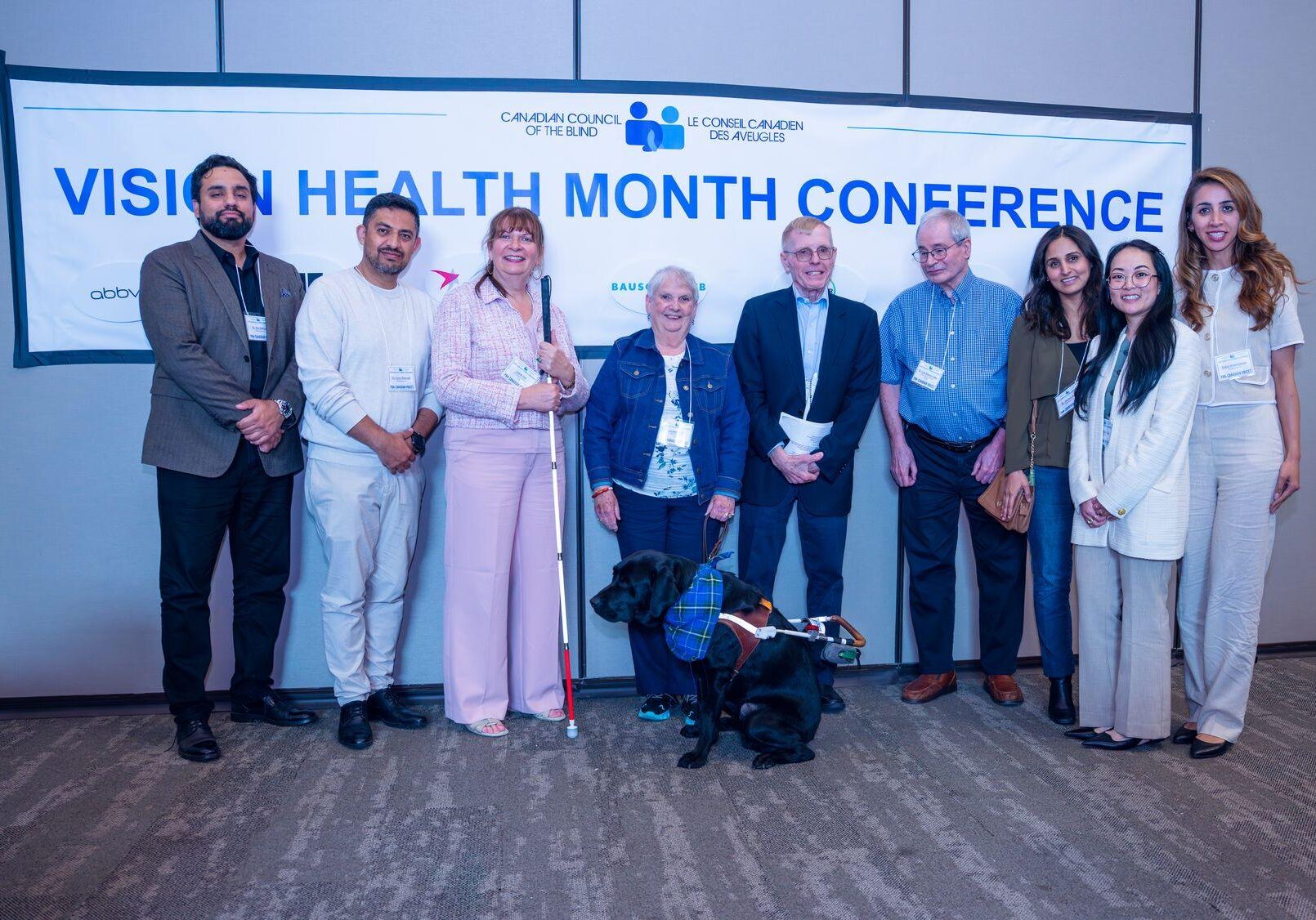
(Description of image: Individuals representing Specsavers smile and pose for a group photo, with CCB’s Leslie Yee, Louise Gillis and her guide dog, Monk, Jim Tokos, and Leo Bissonnette in the center. Behind them is a banner displaying the CCB logo and the words “Vision Health Month Conference” in blue on a white background.)
The recording of the Canadian Council of the Blind’s 2026 Vision Health Month Conference, Pan-Canadian Voices, is now available online. The conference brought together researchers, healthcare professionals, advocates, service providers, and community leaders from across Canada to discuss vision health, eye care access, rehabilitation services, accessibility, public awareness, and national advocacy.
In the recording, you will hear from:
- Angelica Hanna on socioeconomic factors and barriers to eye care across Canada.
- Dr. Allison Scott on eye care delivery from both East Coast and national perspectives.
- Jim Tokos, Leslie Yee, and Jessa Ross on the launch of CCB’s Right to Sight Campaign.
- Jennifer Urosevic on the Vision Health Partners’ Coalition and the National Strategy for Eye Care Act.
- Catherine Langlois of VIA Rail Canada on a national accessibility plan and inclusive travel across Canada.
- Dr. Yasmin Jindani on behalf of Dr. Sabri Kourosh about the Indigenous Children’s Eye Examination (ICEE) Project.
- Kamilia Zaman, Leo Bissonnette, and Richard Marsolais on vision rehabilitation, services, equity challenges, and regional differences across Canada.
To view the conference recording, please visit the following link:
https://youtu.be/TDuyiuHyJAE
Thank you to our speakers, panelists, sponsors, partners, staff, volunteers, and attendees for supporting this important national conversation on vision health in Canada.
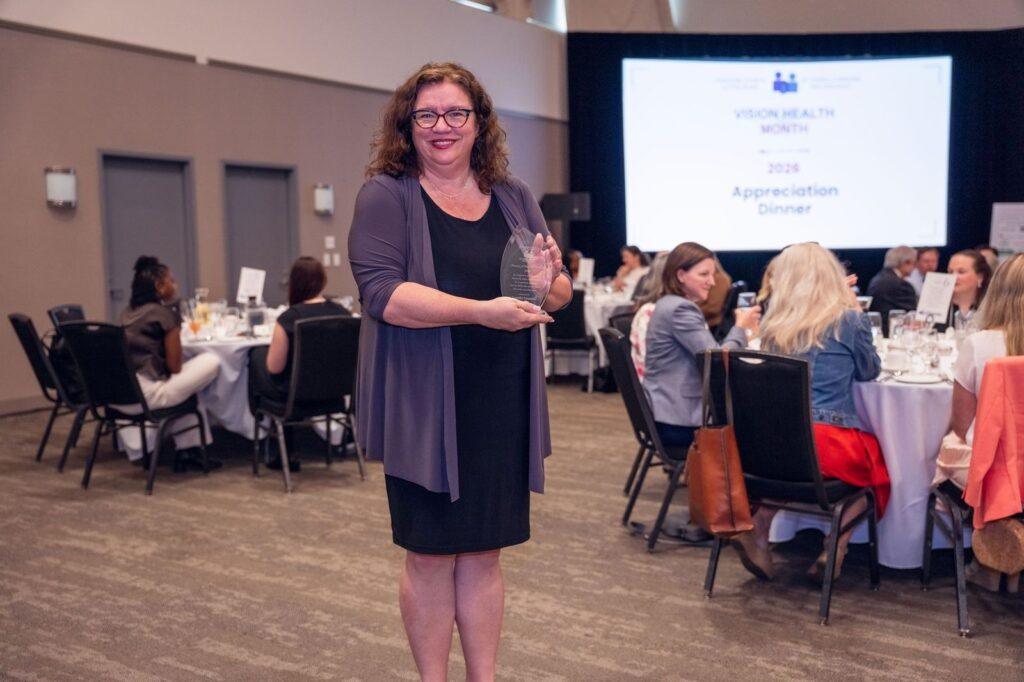
(Description of image: Jennifer Urosevic, President of Vision Loss Rehabilitation Canada, stands smiling while holding the Canadian Council of the Blind’s Person of the Year award. She is wearing a black dress with a dark purple cardigan and poses proudly with the award in hand. People are seated at tables behind her, with a presentation slide displayed on a screen in the background.)
Six Dots Strong: Braille Transcribers’ Recognition Day, June 6th:
Join Braille Literacy Canada in celebrating Braille Transcribers on 6/6/26!
In recognition of our braille transcribers across Canada and around the world, we are asking that you take time on June 6th to acknowledge their work in the transcription of braille and production of tactile graphics. Whether it be a novel, a textbook, your bank statement, a menu or accessible resources for students in the schools, braille transcribers are an essential support in the production of braille copy. These highly skilled professionals are responsible for formatting and transcription of print copy into braille file and embossed braille.
It is not just a matter of knowing the braille code but involves several areas of expertise, including formatting braille copy, proofreading braille copy, and the production of tactile diagrams.
Curious about becoming a braille transcriber? For more information about this essential work, contact: info@blc-lbc.ca.
Thank a braille transcriber near you on June 6th. Six dot strong; say it with 6 chocolates, 6 fragrant flowers, 6 reasons to thank a braille transcriber.
Disability Justice and Disability Advocacy—What’s the Difference and Why It Matters:
In the blindness and low vision community, people sometimes use the terms disability advocacy and disability justice as if they mean the same thing. They are related, but they are not the same. Understanding the difference helps us build a stronger and more inclusive future.
Disability advocacy is about removing barriers and improving access. This includes things like making transit accessible, adding tactile signage, getting funding for assistive devices, or making sure health information is available in Braille, large print, audio, or digital formats. Advocacy works within the systems we already have, to make them fairer for blind and low vision people.
Disability justice goes further. It asks bigger questions, such as:
- Why does this barrier exist?
- Who gets to decide what changes are made?
Disability justice centers the lived experience of people with disabilities, especially those who face additional barriers because they are racialized, low income, from the LGTBQ community or have multiple disabilities. It challenges the systems and attitudes that shape healthcare, policy, and society. It also insists that people with disabilities lead the work, not just give feedback.
In the vision loss community, this difference is important. Advocacy might help improve access to eye care services. Disability justice asks why blind and low vision people are still missing from leadership tables. Advocacy might improve rehab programs. Disability justice asks how poverty, colonialism, or gender based inequality affect who can access those programs in the first place.
Both approaches matter.
Advocacy helps people navigate daily life.
Disability justice works to change the systems that create barriers in the first place.
Together, they help build a future where blind and low vision Canadians don’t just have access, they have power, voice, and real equity. And most importantly, all of us who are blind or have low vision are advocates. We speak up for ourselves every day, and we need to keep using our voices to stand up for our rights and shape the world around us.
Submitted by The CCB National Advocacy Committee.
Elections Canada’s Accessibility Plan:
We are pleased to share that Elections Canada’s Accessibility Plan 2025 is now available in the following formats: Word, PDF, ASL (American Sign Language) and LSQ (Langue des signes Québécoise). Additional formats, including large print, braille and audio are available upon request. We have also published 2025 Accessibility Progress Highlights – Elections Canada.
This plan is particularly important as it incorporates some of the barriers identified during the 45th General Election through feedback shared by partners and electors. We would like to take this opportunity to thank everyone who contributed their insights during and after the last general election.
We encourage you to share our new Accessibility Plan within your communities and networks.
We look forward to continuing to advance our accessibility commitments in the months and years ahead.
“Balance” with Douglas Panton—Presentation Transcripts Now Available:
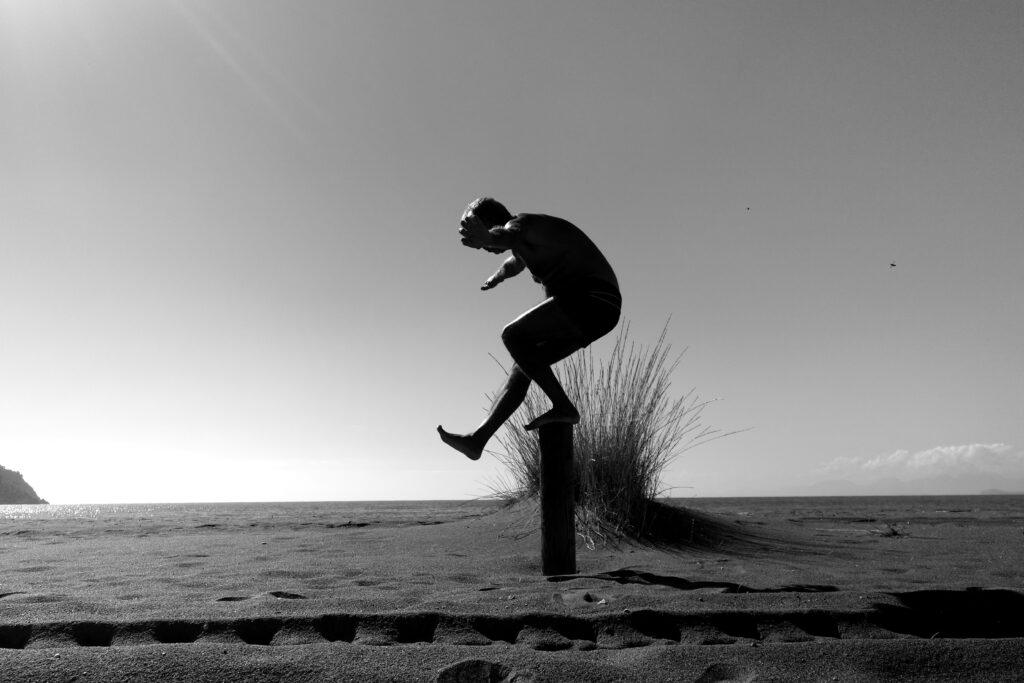
(Description of image: A grayscale image of an individual balancing on one leg with their arms raised on a small pillar in the sand. The ocean can be seen behind.)
We are pleased to announce that transcripts are now available for both “Balance” with Douglas Panton presentations, which took place on February 19 and March 5, 2026. These engaging sessions offered valuable information and practical strategies to help participants better understand balance and support safer everyday movement.
Presenter – Douglas Panton:
Douglas Panton is an Anatomy and Physiology Professor from Victoria, BC.
First Presentation – February 19, 2026:
In the first presentation, Doug discussed the science of balance, why balance can change over time, and how vision loss can affect the body’s ability to maintain stability.
Second Presentation – March 5, 2026:
In the second presentation, Doug focused on practical ways to improve balance and reduce the risk of falls.
To request one or both transcripts, please contact us at ccb@ccbnational.net.
IN THE NEWS
Life-changing eye implant helps blind patients read again:
A group of blind patients can now read again after being fitted with a life-changing implant at the back of the eye.
A surgeon who inserted the microchips in five patients at Moorfields Eye Hospital in London says the results of the international trial are “astounding”.
Sheila Irvine, 70, who is registered blind, told the BBC it was “out of this world” to be able to read and do crosswords again. “It’s beautiful, wonderful. It gives me such pleasure.”
The technology offers hope to people with an advanced form of dry age-related macular degeneration (AMD), called geographic atrophy (GA), which affects more than 250,000 people in the UK and five million worldwide.
In those with the condition – which is more common in older people – cells in a tiny area of the retina at the back of the eye gradually become damaged and die, resulting in blurred or distorted central vision. Colour and fine detail are often lost.
The new procedure involves inserting a tiny 2mm-square photovoltaic microchip, with the thickness of a human hair, under the retina.
Patients then put on glasses with a built-in video camera. The camera sends an infrared beam of video images to the implant at the back of the eye, which sends them on to a small pocket processor to be enhanced and made clearer.
The images are then sent back to the patient’s brain, via the implant and optic nerve, giving them some vision again.
The patients spent months learning how to interpret the images.
Mahi Muqit, consultant ophthalmic surgeon at Moorfields Eye Hospital in London, who led the UK arm of the trial, told the BBC it was “pioneering and life-changing technology”.
“This is the first implant that’s been demonstrated to give patients meaningful vision that they can use in their daily life, such as reading, writing.
“I think this is a major advance,” he said.
For the research, published in the New England Journal of Medicine, 38 patients with geographic atrophy in five European countries took part in the trial of the Prima implant, which is made by California biotech Science Corporation.
Of 32 patients given the implant, 27 were able to read again using their central vision. After a year, this equated to an improvement of 25 letters, or five lines, on an eye chart.
For Sheila, from Wiltshire, the improvement is even more dramatic. Without the implant, she is completely unable to read.
But when we filmed Sheila reading an eye chart at Moorfields Hospital, she did not make a single error. After completing it, she punched the air and cheered.
‘I am one happy bunny’
Sheila says she rushes her chores every day in order to sit down and put on the special glasses.
The task took huge concentration. Sheila had to put a pillow under her chin in order to steady the feed from the camera, which can focus on just one or two letters at a time. At some points she needed the device switched to magnification mode, especially to distinguish between the letters C and O.
Sheila began losing her central vision more than 30 years ago, due to loss of cells in the retina. She describes her vision as like having two black discs in each eye.
Sheila gets around using a white cane because her very limited peripheral vision is completely blurred. She is unable to read even the largest street signs when outdoors.
When she had to give up her driving license, she says she cried.
But after having an implant fitted around three years ago, she is delighted by her progress, as is the medical team at Moorfields.
“I am able to read my post, books, and do crosswords and Sudoku,” she says.
When asked if she ever thought she’d read again, Sheila replied: “Not on your nelly!”
“It is amazing. I am one happy bunny,” she adds.
“Technology is moving so fast, it’s amazing that I am part of it.”
Sheila concentrates hard in order to read.
Sheila doesn’t wear the device when outdoors. In part, this is because it requires great concentration – her head has to be held very still in order to read. She also does not want to become over-reliant on the device.
Instead, she says she “rushes her chores” at home each day before sitting down and putting on the special glasses.
The Prima implant is not yet licensed so is not available outside of clinical trials, and it’s unclear how much it may eventually cost.
Nonetheless, Mahi Muqit said he hoped it would be available to some NHS patients “within a few years.”
It’s possible the technology could be used to help people with other eye conditions in the future.
Dr. Peter Bloomfield, director of research at Macular Society, says the results are “encouraging” and “fantastic news” for those who currently have no treatment options.
“Artificial vision may offer a lot of hope to many, particularly after previous disappointments in the world of dry AMD treatment.
“We are now watching closely to see if the Prima implant will be approved for use here in the UK, and crucially whether it could be made available on the NHS.”
The trials are not expected to help those with conditions where the optic nerve, which sends signals from the retina to the brain, is not functioning.
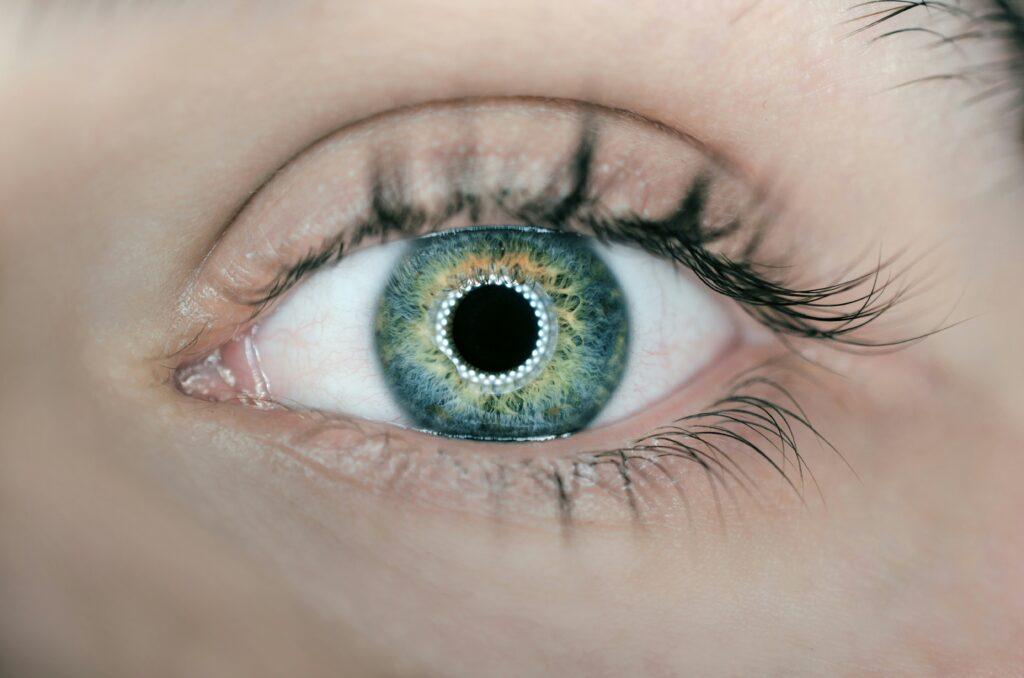
(Description of image: Close-up of an eye in shades of turquoise, blue, green, light yellow, and orange. A ring of lights can be seen around the black pupil.)
By Fergus Walsh, Medical editor, BBC News.
Calgary Athlete Dagmar Jamieson Won’t Let Being Legally Blind Stop Her:
When Dagmar Jamieson was diagnosed with macular degeneration and declared legally blind, she didn’t let it stop her drive for sports. Sports have always been a big part of life for Dagmar Jamieson. She has figure skated, danced, and skied.
Even when Jamieson was diagnosed with macular degeneration and declared legally blind, she continued to ski.
Jamieson says nothing was going to stop her.
“I loved skiing. That was my recharge—to go to the mountains.”
From the slopes to the water.
As the years went by, Jamieson’s vision got worse and downhill skiing was no longer safe.
A friend suggested she try water skiing.
Her first time was with Canada’s national team and Jamieson says she was hooked.
“I was really inspired by those adaptive athletes,” she said.
“I got up on my skis, on two skis at first, and then I dropped a ski, and I said, ‘I’m in.’”
When she’s out on the water, Jamieson needs help.
She uses a waterproof helmet that has a communication device attached.
It allows her coach to talk to her and give her directions.
Even though she’s 65 years old, Jamieson says she still has some big goals in mind.
“I’m inspired to make the team for the 2027 worlds, which will be in Canada,” she said.
“I’ll continue to practice and work hard.”
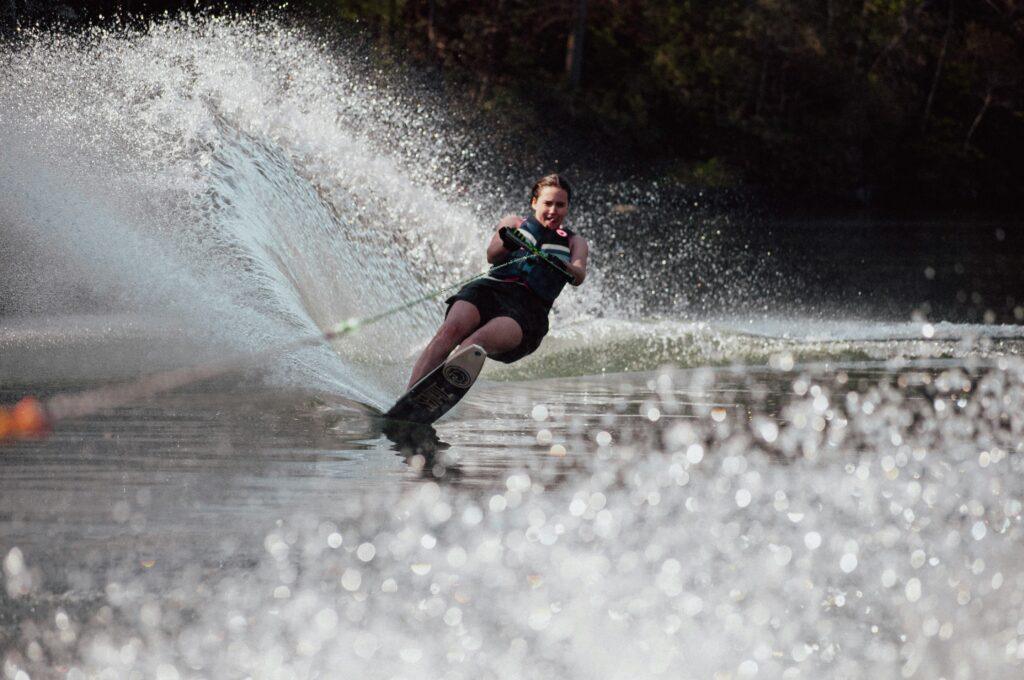
(Description of image: A person wearing a life jacket and shorts water skis across the water, holding a tow rope as water splashes around them on a sunny day.)
Also, an author.
Jamieson is also an author who has written several books.
She says they’re about how AI and technology can help people with disabilities.
“These are poignant and personal stories from people where they talk about how AI and technology have enhanced their lives.”
Still has hope of regaining vision.
Jamieson says there are about 40 new clinical trials right now that may be able to restore or help stop her degeneration.
She says being able to see again would be a dream come true.
“To be able to see, are you kidding?” she said.
“I can’t even imagine how that would inspire my life. I could look you in the eye. I could look my son in the eye, which I haven’t been able to do since he was born.
“That’s one of the biggest things that I miss is human connection—to be able to see someone across the street and recognize them.”
By Glenn Campbell, CTV News.
United Kingdom Blind Man is First to Pull Pints At Beer Festival:
It is believed Kevin Ramsey will be the first blind person to work at the East Anglian Beer and Cider Festival.
A man who lost his sight about seven years ago will be the first blind person to pull pints at a beer and cider festival.
Kevin Ramsey will be serving at the East Anglian Beer and Cider Festival at St Edmundsbury Cathedral.
Mr. Ramsey, a volunteer with Suffolk Sight, previously pulled pints at one of the charity’s functions and wanted to give it a go on a larger scale at the event in Bury St Edmunds, Suffolk.
Geoff Staff, chair of trustees at Suffolk Sight, said he expected the customers to “love” the new barman.
Mr. Ramsey explained that Mr. Staff would give him a count of “one, two, three, stop” to help him serve drinks in measures of a third of a pint, a half-pint, or a pint without overtopping the glass.
“I want to be able to prove that we can do it so it helps other people to see if they can do it,” he said.
Festival organiser Paul Cooper said he believed it was a first for the festival to have someone with sight loss serving.
“I think there’s going to be a big queue at the bar. I’m going to be at the front of it,” he said.
Mr. Ramsey has spent some time training for the festival.
It involved getting a feel of the area around him as well as for the beer casks, ready for the 30 hours he will spend there in aid of Suffolk Sight.
Payment for drinks will be taken by someone else working with Mr. Ramsey.
“A person who has experienced sight loss has a much better awareness of their space around them,” Mr. Staff said.
“Kevin is absolutely amazing. He’s fantastic at learning the space around him and within a very short amount of time, he knows how to serve somebody and he’s just brilliant with people.”
“The great thing is that the punters love it, too. They like that experience; they cannot believe it. There’s a buzz around Kevin.”
By Alice Cunningham, BBC News.

(Description of image: Close-up of hands raising glasses of beer with greenery visible in the blurred background.)